Feeds:
Posts
Comments

Archive for March, 2019

Brighton, the south coast town to which I used to resort for fun and diversion when I lived 20 miles up the road, has few claims to historical fame. The Prince Regent slept there, and rarely slept alone.

But in 1862 it was the scene of a historically important accident. Trains leaving Brighton in the general direction of London have to face a long climb up the South Downs, before they reach the Clayton Tunnel, which gave, and still gives, access to the more easy-going scenery of the Weald.

In the 1860s trains operated on the “time interval” system. A train leaving the station would be given a five-minute start before another one would be sent after it. And that was it. The trains were quite slow.

On the day in question three trains left the Brighton station and headed for the tunnel (picturesque north portal pictured below). Train number one passed the signal box before the tunnel and entered the portal. The signal at that point should have automatically moved to “stop”. It did not. A gadget was provided to warn the signalman that this important event had not occurred but by the time he realised what was going on train number two had passed the signal. So he waved a red flag from his window as the train went by.

Minutes passed. Train number three appeared, and waited at the signal which he had manually moved to “stop”. At this point the signalman made a serious mistake. He sent a message to his counterpart at the other end of the tunnel asking if the tunnel was clear. This gentleman, having just seen train number one storm past his box, replied that it was.
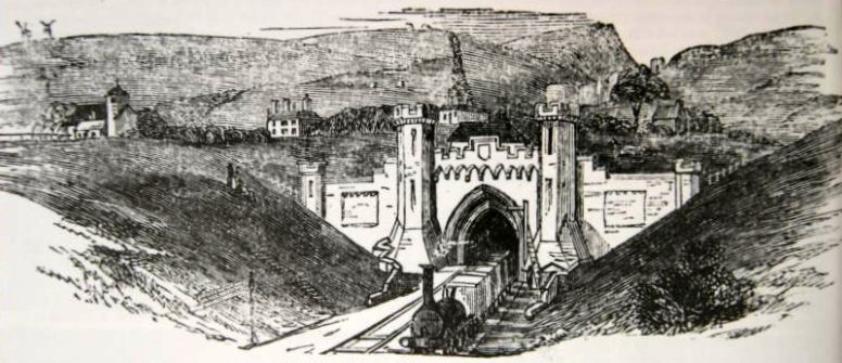
So our signalman duly sent train number three into the tunnel. Unfortunately the driver of train number two had seen the red flag. He had stopped his train, a procedure which took some time in those days. And then he started reversing back towards the tunnel entrance.

The resulting collision inside the tunnel caused 300 casualties. As generally happened with coal-burning engines and wooden carriages the wreckage caught fire. Rather surprisingly only 23 people died but the railways were in their infancy – in its day this was the worst accident ever.

The accident achieved instant fame because it was the inspiration for a popular ghost story by Charles Dickens, “The Signalman”. The tunnel is still rumoured to be haunted.

More seriously, in consequence of the crash the time-interval system was rapidly abandoned, and replaced by what was known as the “absolute block” system. Under this the track is divided into sections called “blocks” and the signalling system is set up so that only one train is ever allowed into a block at a time.

Of course this did not prevent all accidents, or even all collisions between trains running on the same track. Human beings can be very ingenious, or very careless.

Times have changed, signal boxes have disappeared, equipment has become more sophisticated and knowledgable. But still the block system has been a fundamental feature of safe railway operation for some 150 years.

So I was a little disturbed to read, after the latest MTR incident, that the corporation was testing some software which would abandon this fundamental principle, and allow the trains to chase each other round the network, saved from disaster only by an omniscient computer.

I understand that this is a way of increasing the capacity of the system, but the latest accident was on what is known as a scissors crossing. Most of the time an MTR train is following another MTR train and has another following behind it. The worst likely problem is that one driver will have to brake sharply to avoid his predecessor.

A scissors crossing has more exciting possibilities, because it is a junction where trains can go in one direction or the other but not both. You can, as it were, have a train going Route A-to-Route B or a train going Route B-to-Route A. If two trains attempt this simultaneously they will collide.

Unfortunately a network like the MTR needs a lot of these. If a train arrives at the end of the line in, say, Kennedy Town driving on the left it cannot simply go back the way it came. It needs to switch to driving on its new left. This can be done in a number of different ways but the easiest and cheapest is to have a scissors crossing just outside the station so that trains can go from the in-bound track to the out-bound one either before or after visiting the station.

Clearly this is a problem from a signalling point of view, because this gives us eight possible routes through the resulting junction (four in each direction) of which two pairs do not conflict with each other and four involve a possible collision.

It would, I suppose, be surprising if we could not find a computer somewhere capable of managing this tricky situation. But because of the consequences of error, it will have to be extremely reliable, which rules out any of the computers of my acquaintance.

One wonders why they did not avoid this complexity by separating the cross-overs. The scissors looks good on a model but it is really just two cross-overs super-imposed. The left-to-right one doesn’t have to be in the same place as the right-to-left one. Perhaps that would be more expensive.

Well I suppose they know what they are doing. It is nice to hear that the MTR is trying to improve things. You have to wonder, though, if this is a good time to introduce a spiffy new system when they seem to be having so much trouble operating the present one.


Read Full Post »

It is not often that a government press event has me rolling on the floor laughing. So I would like to thank Secretary for Development Michael Wong for his priceless performance on the Lantau Vision thing.
Reclamation for the first new island, he said, would begin in 2025. The first residents “may” move in by 2032. That allows seven years for the lot: the whole transition from placid patch of sea to completed public housing estate.
I am reminded of the United States Senator who greeted a particularly rosy official forecast by asking if he was expected to believe in the tooth fairy as well.
Let us look at our government’s record as a user of a large piece of reclaimed land. In 1998 the Kai Tak airport closed, leaving some 300 hectares free for new uses. If Mr Wong had been in charge the first tenants “might” have been moving into the resultant new housing in 2005. He wasn’t.
In fact, so far, two public housing estates have materialised. In both, according to the government website, the first tenants moved in in 2013. That’s 15 years after the government inherited a piece of land already reclaimed.
The rest of the Kai Tak site contains two completed projects – a new office block for the Trade and Industry people and the famous Cruise Ship Terminal. These take up very little of the space, of course. The rest is at various stages in the progression from “temporary” outdoor par park through building site to completed project.
The new Kai Tak MTR station looks almost finished from a distance. As it is completely surrounded by construction deserts of various kinds I suppose the corporation must regard not having to operate it yet as the sunny side of the delays to the Shatin to Central link.
In the light of the lamentable performance on the Kai Tak site it appears that even if the Lantau Vision reclamation starts in 2025 the first residents might move in about … oh … 2040? This is a very long-range project. Do we detect a hint of hubris in the assumption that the government has the faintest idea what Hong Kong, or indeed the world, will be like by then?
I notice also that roads will be installed by the time the residents move in – so thoughtful! – but the railways “might not run until three or five years later”. Come, Sir, do not be so constipated in your imaginings. If the railways follow recent precedents they might not run until ten years later, if at all.
I fear the government is going to repeat the mistake made in turn in Shatin, Tsing Yi, Cheung Kwan O, and Tin Shui Wai at different times. In each case residents were moved in when the only public amenity was one of those bus stops KMB makes by sticking a pole in a recycled wheel. Epic tales of misery and tedium ensued.
There will be roads. Will there be markets, parks, teahouses, malls, cinemas, a Town Hall, even perhaps the odd dai pai dong? Or will all these things have to wait while the new estate is filled with public housing applicants who cannot refuse an offer without losing their place in the queue?
Well I still think the whole thing will be ripe for cancellation at some future date “in the light of changing circumstances”. After all the price has already zoomed from “about $500 billion”, (nameless source explaining the budget) to $624 billion (Mr Wong’s latest estimate). If it eventually reaches $1 trillion (educated guess from Chu Hoi-dick) it will have done no worse than the Express Rail did, though on a larger scale.
But we are surely not that stupid. It’s not the Lantau Vision. It’s the Lantau Mirage, shimmering in the distance as we slog through the desert. Don’t drink too much of your water.

Read Full Post »

What is the nature of a university? Since the times of the great Prussian educational reformer Wilhelm von Humboldt it has been regarded as a community of scholars and students who on a basis of freedom and equality pursue knowledge together.

Clearly this is not the way they see things at the Hong Kong Polytechnic University.

The students had a noticeboard. Some of the notices which appeared on it aroused the disapproval of the Poly U management. They had the notice board covered in red paper and announced that they had “resumed” control over it.

The students protested. Some of them tried to visit the university’s top administrators to protest personally. The university backed down and restored the noticeboard to the students’ union.

It also brought disciplinary proceedings against four students who, it said, had “misbehaved by assaulting school staff, refusing to comply with orders, and exhibiting conduct in detriment to the school’s reputation.” Some of them had “defamed” an administrator.

The four were a master’s degree student, who was expelled, the past president of the student union, who was suspended for a year, the student member of the university council, who was sentenced to 120 hours of community service, and the union’s external affairs person, who got 60 hours.

How these decisions were made we do not know and we are not going to know. The relevant committee meets in private and the Poly U refuses to discuss the matter out of respect for the privacy of the condemned students, a convenient refuge.

Now I have a sort of personal interest in this, which I had better insert briefly here. I was myself, at different times, a master’s student, a student union president, and an elected student member of a university council. I was also, for a while, the chairman of a university disciplinary panel.

This was all in another country and another century, and it certainly feels like it when compared with recent events here. While I was a master’s student I participated in a weekend-long occupation of the entire London School of Economics. Nobody was hauled before a tribunal of any kind as a result, though the school did decide to upgrade its gates.

While I was a student union president the students occupied the administrative building of our university for the best part of a week. This might have led to a chasm opening between staff and students, as it did to some extent at LSE.

We nevertheless managed, due to hard work by people on both sides of the dispute who thought it was important, to remain on speaking terms generally and, again, there was no disciplinary action of any kind.

While I was the student rep on the council there was an academic strike. Again, no sequel, at least for the student participants.

No doubt some people in Hong Kong will regard this history generally, and the fact that I was not personally expelled, as examples of that laxity which leads to chaos in decadent Western democracies. How much more bracing it would have been if everyone concerned had been sent to a re-education camp!

This is unfair. The idea of a university education is, as Humboldt put it, to “enable students to become autonomous individuals and world citizens by developing their own reasoning powers in an environment of academic freedom…  Knowledge should be formed on the basis of logic, reason, and empiricism rather than authority, tradition, or dogma.”

These aspirations have implications for the way a university is run. It is not a kindergarten, nor even a secondary school. Students are adults who are entitled to their own opinions and also to human rights, of which freedom of speech is one.

If these opinions are expressed strongly or physically, that is a problem which the university as a community needs to work on. Swift resort to punishing a few individuals is not a solution; it is a contribution to the problem.

I realise there is an unfortunate history here. When the polytechnics were polytechnics they were managed in conformity to a long if rather inglorious tradition imported from the UK: students were regarded as passive raw material being processed down the production line by a staff of academic serfs under the rule of a despotic management. Becoming a university should have changed all that. Did it?

There may also be a cultural problem. Maybe some of the more conservative administrators think that staff-student relations should proceed along the lines indicated by the old geezer with the white beard in Kill Bill who punishes a cheeky pupil by poking her eye out.

Or it may be that some people are trying to get ahead of mainlandisation, as it were.

Whatever the reason, it cannot be disputed that the Poly U is not looking good at the moment. It seems that the arrival of ten students in administrative territory is regarded as an invasion, and that the reaction of senior administrators to a student knocking on the door is to lock the door and dive under the desk.

There is no need for this. Students can be unreasonable and noisy but they don’t bite.

Some serious thought is needed to the matter of discipline. In academic matters it is clear that a university’s teaching staff have to exert the powers needed to uphold standards: to prevent cheating, to ensure fair assessment, to design the curriculum, to keep exam papers secret and so on.

In non-academic matters the situation is rather different. All members of the university community have a stake in the preservation of peace and property. There is no reason to suppose that academics are particularly good at this. In our system – where the JUPAS system gives one take-it-or-leave-it offer – we can hardly say that a student’s admission implies consent to being subject to the forensic fumbling of a bunch of amateurs.

If the complaint is of a crime then it should be passed to the police unless everyone concerned agrees to an internal solution. Defaming a vice president is not a crime; it is an exercise of free speech and if the vice president objects he should be left to sue like everyone else.

The offence of “conduct in detriment of the school’s reputation” is a piece of nonsense. People conduct themselves in ways detrimental to their schools’ reputations all the time. Professors fake their research records, fake their current activities, have affairs with other professors’ wives or – worse – with students.

It is often said in university PR circles that every university in Hong Kong has an undiscovered scandal it is sitting on in the fervent hope that it will never surface. Most of us would have forgotten about the Poly U’s little fracas if allowed to do so.

Sentencing people to hours of community service should be left to proper judges unless the Poly U’s disciplinary panel is prepared to go the whole hog in preserving the legal rights of potential convicts, up to and including the right to legal representation.

This whole affair would be a disaster without the whiff of politics hanging over it, but alas whiff there is. The Poly U’s sudden enthusiasm for censorship followed student enthusiasm for Hong Kong independence.

This matter of independence is a minority pursuit of no practical significance and its main attraction is that it gets up the nostrils of politicians, mainland officials and other people for whom students rightly have little respect.

It is an exercise of free speech. No doubt exercising this right for the purposes of provocation could be considered immature behaviour. The response to it should not be equally immature. The answer to incorrect speech is correct speech, not censorship.

Read Full Post »