Feeds:
Posts
Comments

Archive for January, 2023

I have been writing opinion pieces and op eds on and off for about 50 years. One gets occasional feedback, sometimes praise, sometimes criticism. I try not to be inflated by flattery or downcast by brickbats. Still, after so long it is nice to get some original advice.

This brings me to the current trial of sundry employees, and the owner, of the Stand News web channel, on charges of sedition. Prosecuting counsel Laura Ng, while cross-examining a former editor, suggested that all commentaries should be “balanced”.

The editor’s answer to this was much more polite than mine would have been. I do not wish to imply in any way the guilt or innocence of anyone on trial in this case, which would be quite improper. No doubt the judge would not be influenced in any way by anything I wrote here anyway.

But in the interests of what is left of Hong Kong journalism we need to establish firmly that it is neither necessary nor desirable that opinion pieces should be “balanced”.

There is certainly a case for balance in news reports. This is why reporters like conflicts which have two clear sides – Labour versus Conservative, strikers versus an employer, the prosecution versus the defence. Balance is achieved by giving roughly the same amount of space and attention to each side.

In more complicated disputes the matter becomes difficult. On environmental matters, for example, there will be a variety of different views ranging from the prophets of doom to the spokesmen for complacency, with many niches and specialities in between.

There is also the question of when a view becomes so outlandish that we can effectively ignore it. Writers about the holocaust do not feel it necessary to include in every piece a paragraph acknowledging that some people deny it ever took place. Space stories do not acknowledge flat earth theories and stories about the British Royals ignore the rival claims to the throne of the descendants of James II.

Other offerings are more difficult to categorise. Are we obliged to note the objections of the small but noisy groups opposing vaccination, fluoride in water, or the results of the last presidential election?

Editorial writers are generally spared these headaches. An opinion piece is supposed to be about an opinion. The editorial – if your news outlet still has one – expresses the opinions of the editor or proprietor. News outlets aspiring to persuasion will attempt a serious tone, and as part of this may acknowledge that on a particular topic their view is not the only one.

By-lined opinion pieces – those with a named author – are free to expound a view.

That does not, of course, mean that gullible readers will necessarily be swayed by it. Let us suppose that some hypothetical columnist believes that the “so-called” Department of Justice is staffed largely by mercenary mediocrities who, having sold their souls for a well-filled iron rice bowl, have little knowledge and less care for the rights on which they are expected to trample.

Readers of this deplorable diatribe do not need a reminder that the Secretary for Justice takes a very different view of the matter. Indeed the secretary has many opportunities to make this clear even if he doesn’t (as the present one does) write op eds for sympathetic news outlets himself.

Balance is achieved overall because we report the secretary’s speeches and print his department’s press releases, on other occasions. This possibility is specifically catered for in the law on court reporting, which recognises that on any one day the proceedings will often be dominated by the prosecution or the defence. Coverage remains ‘fair’ (an important matter for defamation purposes) as long as you cover the other days as well.

Our government puts out a great deal of stuff, which the media generally gobble fairly uncritically. Critics struggle to get a word in.

This brings us to another point about “balance”, which is that it assumes that, outside the media outlet concerned, ideas are competing on a level playing field. This is not the case at all. Governments and other organisations have large operations dedicated to the manipulation of public opinion.

When I was a working reporter we all knew that some of the people engaged in this activity could not be relied on for a straight answer. We printed their lies in the interests of balance and tried to alert readers by the use of verbs like “claimed” or “asserted” where we might normally have stuck with “said”.

These PR people were often under great pressure to get the desired result. In the days when I provided short courses for government information officers I was routinely told that their immediate superiors had no interest in explaining government policy to the public; they expected their information people to stir up personal publicity for the director or secretary concerned.

In the days when hotel coffee shops kept a vat of over-brewed coffee sitting on a hot plate, a reporter (not me, thank goodness) wrote a piece about the low standard of coffee in such places and named names. The hotel identified as having Hong Kong’s most disgusting coffee took immediate action: it sacked its PR person.

Experiences of this kind engender a certain professional skepticism in journalists, a suspicion that unless otherwise stated all idols have clay feet, all emperors have no clothes, and all official statements are deceptive.

Conversely we tend to believe that the poor and oppressed, among their other disadvantages, have few opportunities for getting public exposure for their needs and views. Writing about such issues does not need to be balanced by a detailed account of the responses of the rich and powerful, who need no help.

This is the sort of thing which happens in places with a free press, and it is a concern that it not only does not happen much any more in Hong Kong, but that the forces of law and order seem to find it actually objectionable.

Reading recent court cases it appears that there is now an official view of the events of 2019, based on the observations of the NPC Standing Committee, that the protests were anti-China, pro-independence, and inspired by scurrilous foreigners taking advantage of young Hongkongers whose brains had been addled by the Liberal Studies subject.

Any alternative interpretation can accordingly be prosecuted as subversion. The extradition bill never existed and our policemen are wonderful, OK? Isn’t it wonderful to have a free press!
Read Full Post »

Last week Hong Kong welcomed the appointment of a new Governor – I beg your pardon, a new Director of the Liaison Office of the Central People’s Government in the Hong Kong Special Administrative Region.

The new man, Zheng Yanxiong, was previously the Head of the Office for Safeguarding National Security of the Central People’s Government in the HKSAR. No great policy changes to be expected, then.

The occasion was naturally marked by speeches, and these struck a sunny optimistic note. A typical offering from Mr John Lee: “I am sure that Mr Zheng will continue to co-operate with the HKSAR Government in supporting the promotion of Hong Kong’s integration into national development and making greater contribution to the rejuvenation of the Chinese nation.”

This was followed a day or two later by a distressing announcement, which suggested that perhaps the rejuvenation of the Chinese nation was not as inevitable as Messrs Lee and Zheng thought it was: China’s official population had declined.

In terms of numbers this did not appear to be a big deal – an 800,000 reduction in a population of 1.4 billion – but demographers were gloomy. It is not just the absolute number, apparently, but the implication in terms of the size of different age groups. A large population of the elderly supported by a shrinking population of workers is a problem already for Japan and some European countries. But they started from a more prosperous position than we do.

It is apparently almost impossible to reverse a decline in women’s inclination to have babies, which lies at the root of the problem.

The Western media were fascinated. The Associated Press quoted an American academic as saying that the “looming economic crisis will be worse than Japan’s”.

The BBC spoke to Paul Cheung, Singapore’s former chief statistician, who thought China has “plenty of manpower” and “a lot of lead time” to manage the demographic challenge. “They are not in a doomsday scenario right away,” he said comfortingly..

Reuters quoted demographer Yi Fuxian, who is based in an American university and seems to be the go-to guy for quotes on China’s population figures: “China’s demographic and economic outlook is much bleaker than expected. China will have to adjust its social, economic, defense and foreign policies.”

Reuters is a careful news outlet; it also had an official response: “Kang Yi, head of the national statistics bureau, dismissed concerns about the population decline, telling reporters that ‘overall labour supply still exceeds demand’.”

Beijing correspondents adorned the statistical news with pen portraits of defiantly unpregnant Chinese women and happily childless “Double Income No Kids” couples.

Some of the on-line reporting was less restrained than all this. One financial guru (it is often said that investment advisers are called “gurus” because the word “charlatan” is too long for headline use) said she would give China “two or three years”. She did not make clear whether this was the deadline for the End of Life as We Know It or just the point when China might drop off the menu for international share punters.

Well I am not sure what to make of all this. The immediate effect, as one commentator put it, was psychological. China will shortly cease to be the most populous country in the world. Losing one of your entries in the Guinness Book is perhaps a minor national humiliation. Indeed if the Indian government had got a census together (another POVID victim) we might have discovered that this has already happened. The long run? Anything could still happen.

But there is perhaps a warning here. Countries, like investments, can go down as well as up. The best historical example is perhaps Argentina, which in 1900 was more or less a European-style country in South America, and after a long string of bad choices now looks more like an African-style country in South America.

A more recent example is the UK, which has managed to shoot itself in both feet since the Brexit referendum. Then of course there was the USSR…

We would do well to approach the future with some humility and strive, perhaps, for some flexibility. Current developments, welcome or unwelcome, will not continue indefinitely. Change is inevitable and there is no guarantee that we will see it coming. Integration with China looks a good bet now, but is there a Plan B?

Perhaps the demographic trap will turn out to be a false alarm – all those missing workers replaced by microchips, maybe. But something else will come along. It always does. As Michael Oakeshott put it: “In political activity … men sail a boundless and bottomless sea: there is neither harbour for shelter nor floor for anchorage, neither starting-place nor appointed destination. The enterprise is to keep afloat on an even keel…”

There is also a telling line on this in one of God’s early works: “I returned, and saw under the sun, that the race is not to the swift, nor the battle to the strong, neither yet bread to the wise, nor yet riches to men of understanding, nor yet favour to men of skill; but time and chance happeneth to them all.”

Read Full Post »

Since the dog and I had a snake encounter last summer Lemon refuses to visit our local Country Park. The rather boring local alternative is walking up and down Sui Wo Road. So after years of passing it unnoticed I now resort regularly to Penfold Park.

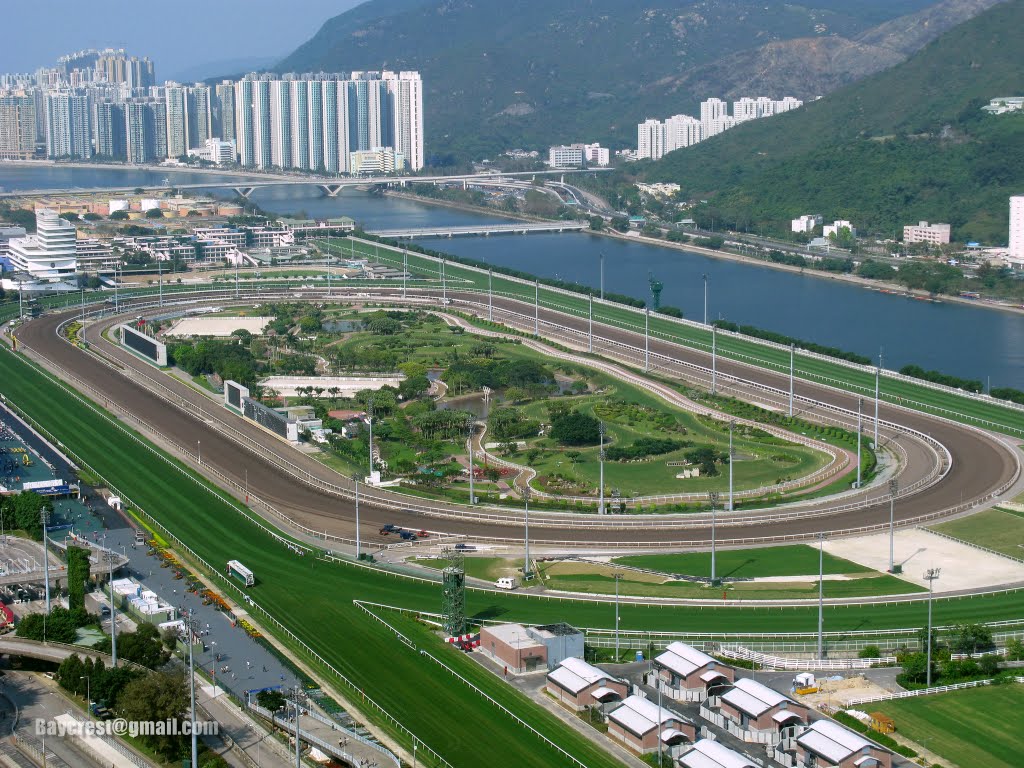
Penfold Park is a unique Hong Kong institution. It is not run by the government or local authority. It occupies the space inside the race-track at the Jockey Club’s Shatin horse casino.

Cynics may wonder if the Jockey Club’s haste to install a public park was in any way motivated by the desire to put something in the space before the government noticed that it was not actually needed for horse-racing purposes, and put something less decorative in there.

A close look at the architecture suggests that in the early days someone cherished the idea that some of the less strenuous horse activities would take place there. There is a trotting track, some practice jumps and a clear space on which one might gallop. But I have never seen so much as a hoofprint so I suppose this idea has faded away.

More successful was the idea that this might be a family attraction. There are toilets, a playground for the kids, and plenty of tables and benches for picnics. And on public holidays or weekends with good weather you do see some parties enjoying alfresco meals.

But the main beneficiaries of Penfold Park are dogs. The park is a dogs’ delight, a pooch paradise, Hong Kong’s hound heaven. Most days a visitor without a dog will feel undressed. On holidays there are dog crowd scenes. The park is decorative, with pools, paths, sculpted bushes and artistically clustered trees. But most importantly for dogs it has a very large area of grass.

Municipal parks in the territory have traditionally been adorned with forests of signs discouraging things: smoking, music, ball games, cycling, roller-skating, radio-controlled cars and, of course, dogs.

Regular readers will have gathered that I am not a great fan of the Jockey Club – an addictive vice does not become a virtue when decorated with conspicuous consumption, snobbery and animal abuse – but I have to admit that with the park the club has done a stellar job. It continues to do so – the park is meticulously maintained, bushes pruned, grass cut, fences painted – and offers no prohibitive notices except a small one pointing out that drones are banned on race days, when the park is closed anyway.

This leads us to one fly in the ointment: there is no public transport. The racecourse has a station, but it is only open on race days. There is a large car park and some people come in taxis. This is not a park for poor people.

Bearing this in mind the observant anthropologist can still spot some interesting characteristics of the local dog population, albeit at the more soignee end of the spectrum.

Interesting mixtures like my Lemon are numerous but not in a majority. The pedigree population comes in two categories. There are the display dogs: Old English sheepdogs, Collies, the odd Afghan hound, some spectacular retired (I presume) Greyhounds. Some of these seem rather impractical for Hong Kong’s climate. Two popular choices in this category are Huskies (anyone for three hours’ exercise a day?) and Samoyeds.

Then there is the most numerous group: very small dogs and extremely small dogs. These are mostly miniature Poodles but Yorkies and other midget breeds are also popular.

The size of this group reflects, I fear, the restrictions which many landlords – notably the government – impose on dog ownership in the properties they rent out or sell. A very small dog can be smuggled in and out in a bag. Designed bags for this purpose are a common offering in pet equipment shops. With your pocket pooch in a bag you can also, in flagrant violation of the regulations, take it on the MTR.

Owners in this category go for pedigrees for two reasons. The dog adoption people will refuse to offer you a dog if you live in an estate where they are banned, because too many dogs adopted in these circumstances are returned. So if you want a dog you must buy one.

From the owner’s point of view a pedigree dog is a better bet because you have a good idea of how big the tiny puppy you are looking at is going to be as an adult, a point on which the adoption people may not be very helpful. Most adoption dogs are mixtures so you cannot exclude the possibility of a Great Dane granddad in the family tree somewhere.

This suggests that the blanket ban on dogs in government-controlled estates has a curious and perhaps not very useful effect. It keeps commercial dog breeders in business and hampers the efforts of those organisations trying to encourage the adoption of existing dogs rather than the breeding of new ones.

A more general public policy worry is the number of young couples whose relationship with their dogs suggests that the pooch may be a surrogate for something else. Small dogs are wheeled out in dog strollers, primped in dog beauty parlours and dressed in cute gear. A newly opened cafe in Shatin catering for owners and their (small) dogs seems to be doing good business.

Is there a consensus among the (disillusioned?) young that raising a dog is preferable to having real kids? After all a dog is cheaper, easier to manage, and will never get big enough to want a room of its own. And you don’t have to worry about the merits of kindergarten classes in goosestepping and flag worship.

Read Full Post »

Romping through the bureaucratic undergrowth the other day I came across a little animal which generally eludes watchers. This is the Advisory Committee on Post-office Employment for Former Chief Executives and Politically Appointed Officials.

I must hasten to add that the subcommittee, though obscure, is not secretive. It produces a steady stream of press releases about its work, which – alas – rarely find favour with media editors. So nobody hears about it.

Generally we are not missing much. The subcommittee vets applications from retiring or resigning political appointees – policy secretaries and their permitted flotillas of assistants – and Specially Appointed Officials, which seems to mean full-time members of the Central Policy Unit, when we had one.

The results are not newsworthy. I cannot find any example in which the subcommittee actually sdvised the government to refuse permission for a job. In every case there is approval subject to some conditions.

In the earliest cases recorded on the subcommittee’s website, which go back to 2012, there is much variation in the conditions imposed, but by the time Ms Carmen Cheung Sau-lai left the job of Political Assistant to the Chief Secretary for Administration in 2014 the committee had settled on a formula which, with some minor verbal elaboration, has been its standard set of terms ever since:

  • No representing people or firms in dealings with the government.
  • No lobbying.
  • No bidding, or advice on bidding, for government contracts
  • No divulging secrets.

Of course they do not put it as briefly as that. Item 4 for example comes out as:

“without derogating from her obligations under the Official Secrets Ordinance (Cap. 521), use, communicate or divulge to any person any classified information or information that has come to her knowledge during her office as Political Assistant to Chief Secretary for Administration that is not already in the public domain.”

But you get the message.

So far this is uncontroversial. Of course we do not want former political appointees exploiting their government contacts. Indeed some of us might consider that the “Relevant Period”, as the subcommittee puts it, could usefully last longer than the current one year.

What may concern us, though, is that the subcommittee has of late decided that it has another purpose besides preventing the indecent exploitation of government experience and contacts, and this is to preserve the government from being “embarrassed”.

As far as I can tell this concern first appeared in 2017 when Mr Fung Wai-kwong left the post of Information Coordinator and expressed a desire to start a new career as (horror!) a newspaper columnist. The committee recommended that he should not be allowed to “include in his articles anything in relation to his employment as Information Coordinator which may cause embarrassment to the Government.”

This condition has appeared sporadically ever since, most recently being applied to Dr Law Chi-kwong, who following a stint as Secretary for Labour and Welfare wished to return to university teaching. People who are threatening to teach during the “Relevant Period”, are often, though not invariably, told not to “include in his teaching materials anything related to his office as [insert job title] which may cause embarrassment to the Government.”

People intending to move to journalism, PR or writing books are also often subjected to this restriction.

And the question which then arises is whether a committee dedicated to avoiding “well-founded negative public perception embarrassing the Government” should be restricting the freedom of speech in this way.

Remember that the people affected are already subject to the item quoted above about information which is not already in the public domain. So it appears that the committee wishes further to suppress information which is in the public domain, but may embarrass the government.

The other possible interpretation is that we are not dealing here with information at all, but the expression of opinions about how the government operates or ought to operate.

Whichever way you look at it this item is a restriction on freedom of expression. Indeed the subcommittee itself calls it a restriction. The right to freedom of expression is not absolute, as we are invariably reminded by people coming up with new ways of trampling on it.There are, though, only a few permitted exceptions, and these are summarised in the Bill of Rights Ordinance. Restrictions are allowed only:

(a) for respect of the rights or reputations of others;

(b) for the protection of national security or of public order (ordre public), or of public health or morals.

Bill of Rights Article 16

I do not see how any of those exceptions could be extended to cover restrictions whose sole effect and intention is to preserve the government from embarrassment.

No doubt there are more worrying freedom of expression issues in Hong Kong than the right of recently defenestrated government servants to give an honest appraisal of their experience, but we must suppose that this subcommittee has legal advice … from government lawyers … from whom we might hope for some sensitivity to the requirements of human rights generally and freedom of expression in particular.

Hope, but not expect.

Read Full Post »