Feeds:
Posts
Comments

The gentle purlieus of our local Anglican cathedral resounded to unaccustomed dissent last weekend. The innovation which had some of the devout pouting in their pews was the addition of the National Flag – I hope I do not need to say that this means the PRC flag – to the usual ecclesiastical adornments.

The flag was not exactly flown. It hung rather limply from a pole, but in a prominent position in front of the pulpit. The idea apparently came from one of our legislative puppets – I beg your pardon, poppets – Mr Peter Koon, who combines the service of an avowedly atheist regime with a position of some consequence in local Anglican circles.

Bishop Mathias Der, presiding, was reported as saying that “We are here to pray for the country, and the flag is here to commemorate [National Day],” which could be considered a bit of an innovation.

He went on to say in his sermon, “If we were to display the British flag before 1997, would there be the same volume of debate online?… mainly it’s because we have some misunderstanding of our country.” But this opens up an interesting question. As far as we know the cathedral did not display the British flag before 1997. Why not?

After all the Anglican church has not exactly been known for taking a critical look at the powers that be. In fact ever since it was founded by Henry VIII as a contrivance for getting his Royal paws on Anne Boleyn’s knickers, it has been notably willing to go along with whatever regime was running the country.

This stellar record of conformity is even celebrated in a satirical song, The Vicar of Bray, which can be found in a reasonably modern version, with subtitles, here. An interesting tabular summary of the way the Book of Common Prayer has sought divine help for the King and the Royal family here.

.We must in fairness note that there is some biblical justification for this flexibility. The founding Christian said we should “render unto Caesar the things which are Caesar’s.” The early influencer later known as St Paul wrote that “the powers that be are ordained of God.”

We must also note that the Anglicans are not the only denomination with political problems. My father’s enthusiasm for Catholicism evaporated during World War 2 when he noticed that young men on both sides were being urged on to kill each other by the same church.

But having accepted all these points in mitigation we are still left with the question: are there some places where it is not appropriate to wave the national flag and is perhaps a Christian church one of them?

This is not a matter of misunderstanding the country concerned. As the Bishop so delicately put it, “There is a period in every country that, if held to the scrutiny of modern standards, would require improvement.”

We do not choose our country. We have to try to cherish the one we are issued.

In most contexts there is nothing controversial about flying the national flag. Outside a government building it is expected, in many places. I am afraid I was raised in a comparatively flag-free environment, where flags usually appeared only outside embassies and international hotels, but one gets used to local variations in this matter.

Some American citizens take a pride in raising and lowering the national flag in their front garden every day. German cities offer a confusing medley of flags because there is usually one for the city, one for the state and possibly one for the region, as well as the national effort.

We must recognise, however, that although many of us may not take it very seriously, the flying of the flag is not a mere municipal adornment. It wordlessly communicates something, and that is why local loyalists who would like to see more people agree with them are encouraging places which did not previously display the flag to get the banner manner going.

Patriotism is a legitimate sentiment – we will leave Samuel Johnson out of this – but it is not a part of religion, and nor is it a part of rationality.

I felt some unease at reports that the Chinese University of Hong Kong was proposing not only to fly the flag on its buildings – an acceptable token of respect for the people who pay for them – but to have a Flag Guard and a ceremonial flag-raising ceremony at formal occasions. This was billed as part of the university’s effort to inculcate patriotism and other worthy urges in its students.

I understand that this particular university has been under some pressure because of the perception in leftwing circles that it is not entirely committed to the new regime and the version of history which goes with it. Still, all this seems dangerously at variance with what should be the university’s primary mission, which is the pursuit of truth through the use of reason. This is not compatible with having a body of doctrine which students are expected to adopt uncritically and without question.

You have to wonder, also, whether now that national education is cropping up everywhere from kindergarten to high school there is really a need to inflict it on university students as well. Surely they will have got the message, if they are ever going to get it?

Flying the flag from a cathedral pulpit raises similar questions. I hesitate to write anything about religion, which is not one of my hobbies, but surely people do not go to church to pray for the country, though they may throw in prayers for a variety of worthy causes while the call is in progress, as it were. People go to church to pray for salvation and forgiveness, I would have thought, to worship and to share the hope of eternal life and other unlikely eventualities.

Bishops who wish to offer spiritual guidance need to know where their boundaries are. We may all need instruction in the comparative merits of various national histories. But this had better not come from them.

There was something engagingly optimistic about the official estimate that the Red Hill Estate – where some homeowners’ illegal extensions were blamed for dangerous landslips during recent rough weather – had maybe another 70 houses with illegal extensions of one kind or another.

Come people, let us be more realistic. It is more likely that almost every house in the estate has unapproved changes of one kind or another. This is only partly because rich people think the planning laws do not apply to them, because you could say the same about almost any village in the New Territories.

The underlying problem is that Hong Kong planning laws are an impossibly clumsy instrument when applied to low-rise housing.

Consider the village of Sheldon in the UK, where one of my esteemed colleagues had a converted farmhouse to which he would retreat between bursts of academic activity. Sheldon is in the English Peak District. It is not pretty in the conventional way that English villages are expected to be pretty; there are no half-timbered cottages, no thatched roofs.

Sheldon’s claim to fame is that it has not changed its appearance in the last 300 years or so. The houses are all low-rise and fairly basic. They are walled in the local stone and roofed in the local slate. The village is a popular backdrop for film and television companies making historical dramas.

This uniformity of appearance is no accident. Every building in the village is now “listed”, which means any change requires the approval of the local authority. Changes which would modify the appearance of a building are simply not allowed. You can have double glazing if it looks like single glazing. Central heating boilers must vent their flues through an existing chimney. Window frames must be wood, or look like wood. And so it goes on.

The concern with appearances is accepted by the villagers because it makes their homes more attractive and valuable. Front gardens are carefully tended to enhance the look of the place. The council follows its own rules. When it reluctantly conceded the need for a bus shelter the resulting construction – in the local stone and slates – was an attempt to build what a bus shelter would have looked like if they had buses in the 1600s.

Hong Kong is not, alas, nearly as good at preserving historic buildings as the UK is. But the rules applying to buildings are strikingly like those found in historic villages. Construction must follow the approved plan. The building, once completed, must remain as planned. Changes need permission and unauthorised ones must be reversed.

This makes perfect sense in a town where most modern residential buildings run to 30 floors or more. Failure to follow the structural parts of plans could lead to a major disaster. Flat owners cannot be given free rein to fiddle with their property. Every flat has to support the flat above and protect from the elements the flat below.

This intrusion on property rights makes less sense when the house is just a house.

Almost every house in the New Territories has a flat roof (except, if the Buildings Office is reading this, mine) on which the owner is expected to be able to walk. In theory this is for open air activities like sunbathing, barbecue or putting out the washing.

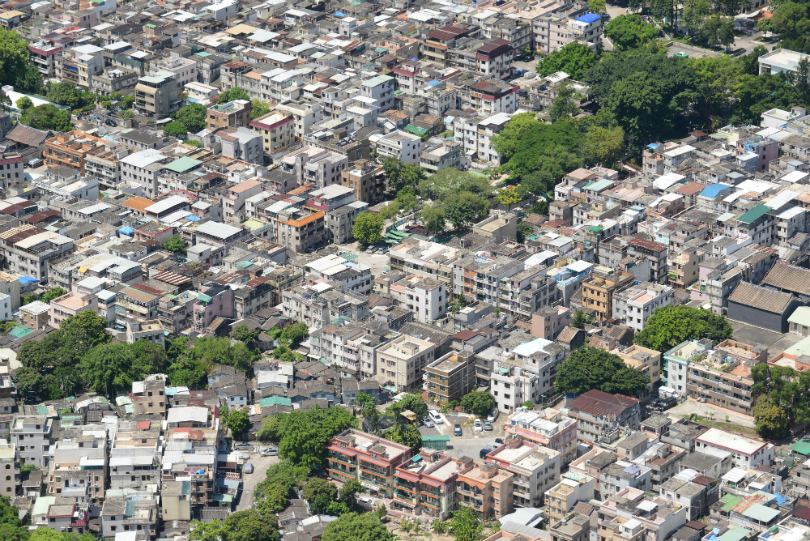
However it’s a load-bearing floor, so most owners erect some sort of structure on it. Look at any rural village from the air and you see a fine variety of rooftop structures, most or all of them illegal.

This is encouraged by routine abuse of the Small House Policy, under which indigenous villagers, if male, can build a three-storey house.

If the villager plans to stay in Hong Kong he can have his “house” constructed as three flats. He can then inhabit the ground floor, let the other two, live on the proceeds and devote himself entirely to exploring the finer points of mah jong. A nice rooftop structure will turn the top flat into something close to a duplex, permitting a higher rent and attracting a better class of tenant.

Another odd feature of the Small House Policy is that the patch allocated to the house is exactly 700 square feet. The “villager” who has exercised his small house rights and now proposes to return to his home in Manchester can only sell you the house, and nothing but the house. Even the land under the balconies invariably supplied remains the property of the government, over which you are allowed to walk to reach your front door.

Of course in wet weather this turns into slushy mud, leading to the construction of a path. This expands by degrees into a patio on which you can park the shopping while you fumble for your keys, inflate the kids’ paddling pool, and other useful things. This looks a bit Spartan so you add flower borders and the odd potted plant. You then discover that these are being browsed by the local wild pigs and put up a fence. You are now in illegal occupation of government land.

These abuses are so widespread they are part of the culture. Architects will design in features which will facilitate surreptitious enlargements later. Builders do not ask if the job they are doing is approved by the government or anyone else.

Homeowners who are well connected to the government’s consultative machinery or the local criminal fraternity (or both; they overlap) do not have to worry about complaints. If there is a complaint, the builder who removes the offending item will offer to restore it once the heat has died down.

At the same time, inspections can be very picky once official alertness has been switched on. One home-owner who obediently removed a glazed structure from his balcony was bemused to receive a visit from an inspector who did not wish to see whether the glass had been removed, which he could see from the street, but wanted to see whether the balustrade specified in the original plans had been restored.

The capricious approach in which nits are picked while elephants in the room are ignored tends to discredit the whole system. People like Leung Chun-ying – and me – who are scolded for having wine trellises in our yards wonder if the relevant department might have more important calls on its attention than garden furniture.

The system is a mess. Asked to suggest changes one is tempted to reply that, as the Irishman put it when asked the way to the Post Office, “If I were you I would not start from here.” Still we must try. Would it be too daring to suggest that occupants of houses up to four storeys high should be allowed to make minor changes at their own risk?

We continue to make legal history of a rather dubious kind. Consider the case of the four Hong Kong U students who appeared in court this week and, after the usual mitigation oratory, were remanded in custody while the judge ponders their sentence.

The first of several interesting things about this event is that the offence was purely an expression of opinion. The four students were among the members of the student council which, the day after a man had stabbed a policeman and then himself, passed a motion lamenting the death of the attacker, and describing him as a “martyr”.

You may think, as I do, that this was a thoroughly misguided opinion. Indeed the students seem after further thought to have come to the same view, because the following day they retracted it.

What boggles my mind, having dabbled extensively in student politics in my time, is the majestic intervention of the law in what is usually considered a rather impractical and private matter.

In student political circles one hears thoroughly misguided opinions in large quantities. Some of them make their way into motions and some of these motions are passed. The passed motion then lands with a soundless plop in the great well of public opinion, which does not, to be very honest, care what students think about anything.

It is true that people once blamed the Oxford Union for World War Two on the grounds that passing a motion that “This house would not fight for King and country” had encouraged Hitler. I cannot think of a more recent example. Riots, protests or occupations attract attention, as they should. The passage of motions causes no ripple in local politics, let alone national ones.

These days I suppose the misguided motion can be put on the internet, like everything else. That does not mean anyone takes much notice of it. Indeed it seems the only reason why the Hong Kong U case became a cause celebre was the storm of abuse from people who disagreed with it.

The result of this, of course, is that an obscure event which happened two years ago is still in the news, as it is here. Competing with all that good news about Hong Kong we have the discovery that ill-considered student oratory is now a serious criminal offence.

Which offence it might be brings us to a curious feature of the recent proceedings. The judge, Adriana Noelle Tse Ching, faithfully followed the current judicial practice of subjecting anything offered in mitigation to scathing criticism as soon as it arrived. This led to a curious discrepancy.

One of the defending counsel pointed out that there had been a plea bargain: the prosecution agreed to drop a charge of “advocating terrorism” and the defendants agreed to plead guilty to “incitement to wound with intent”.

To the untutored lay mind this looks rather as if they are admitting that the motion encouraged an attack which took place the day before it was passed, an innovative concept. No doubt it makes sense to lawyers.

Anyway the deal clearly proceeded on the basis that the incitement to wounding charge was a less onerous one than the advocating terrorism one. But the learned judge rejected this suggestion on the grounds that the maximum sentence for inciting to wound was life imprisonment. Sticking to terrorism would mean a maximum of ten years.

So in her view the defendants had admitted a more serious offence with which they had not been charged, in return for having a less serious one dropped. Was there some confusion here?

The judge, it is reported, said that the students must “bear the consequences of their legal strategy”, which sounds a bit ominous, especially as she followed up with “It’s about time for someone to learn there are consequences to actions.”

It is difficult to know what was going through the judge’s head at this point. Was this a reminder that defendants must bear the consequences of their counsel’s errors? Or was it a comment on the case as a whole, in which case I cannot resist the thought that there was no action here. The crime, if it was a crime, consisted of speech.

There was no suggestion that the deplorable motion was followed by an epidemic of knife attacks, or even by an epidemic of equally objectionable motions being passed by other student unions. It was an error by people who did not know the law.

Rather similar, in fact, to the judge’s own action in having two people’s mobile phones seized on the grounds that the rules require phones to be switched off in court. Not so. The Judiciary’s policy is that you may text, but not talk. In the light of this case you would do well to choose your words with care.

At last a holiday! After three years of COVID confinement I managed to put a spoke in our long-awaited getaway by breaking a bone in my foot a month before scheduled departure.

Medical opinion was gently but firmly in favour of cancelling the whole outing, but after waiting so long and spending so much I decided to go, and promised to treat my foot as gently as possible. I would wear “the boot” at all times. Officially this is a “walking boot” but you can’t walk very far in it.

This led to my insertion into the obscure world of “special assistance”, as they call it in the airport business: arrangements for people who cannot walk, or cannot walk long distances.

It turned out, to my surprise, that there is a great deal of variation in the way this is done.

If you are leaving Hong Kong the arrangement is very simple. You are installed in a chair while the checking-in lady summons your pusher for a suitable time. Your pusher – mine was a lady – turns up with a wheelchair of the usual folding kind, and propels you the whole way to the departure gate, via immigration, security, lift to lower level and a long walk along one of those Chak Lap Kok fingers.

She deposited me in a chair next to the departure gate, and returned at boarding time to make sure I got on the plane all right. This is a splendid arrangement and I am sure a pleasant surprise for visitors from some places. On arrival it works the same way: one solo pusher wheels you from gate through customs, immigration, baggage pick-up and out to your taxi, lift or whatever.

Transiting through Frankfurt is a completely different experience. You are met by a man who takes you upstairs in the lift. There you are passed to another man, driving an electric car. He takes you to the internal train station, where another specialist gets you on and off the train.

Upon arrival you meet another specialist who will take you through immigration and pass you to someone else. It feels rather like a game of football in which you are the ball. I think there were seven passes. On the other hand I must admit that the overall result, coordinated by some distant controller over the mobile phones which everyone consulted regularly, was entirely satisfactory. I was delivered to the right place in plenty of time.

And so on to a short flight to Basel. Basel is a small local airport, whose main claim to fame is that it actually has two exits: one to France and one to Switzerland.

It does not have those tubes down which you walk from the aeroplane to the terminal. Instead there is a wheeled flight of steps which is pushed up to the exit. But I did not have to walk down them. Here we encountered for the first time the Magic Bus. This is officially a Disabled Passenger Vehicle, or commercially an Ambulift. It is basically a van like the ones airlines use to load food and luggage. Its distinguishing feature is that the whole back can be lifted up to the height of the aircraft door.

So I hobbled into the van, which then lowered itself and drove off to the terminal. There is room for three or four wheelchairs and seats for some pushers or traveling companions. We later encountered a subtly different version which is permanently in the “up” position but has a lift to move you up and down.

Next stop was the UK, where the “special assistance” work is generally farmed out to a specialist company. We went through four airports and they all seemed to be wearing the same uniform. They have their own system, in which there are gathering places called “pods”. You are moved from pod to pod, passing through the usual formalities on the way, until you reach the “departures pod” from which you are taken to your gate.

This seemed to work very well with departures. Arrivals sometimes not so good; it seemed they did not have any advance notice of the number of disabled people on the plane, so there was sometimes a shortage of pushers, or of wheelchairs.

UK airports do, though, have a specially designed wheelchair for airport use. It is higher than the standard folding model and easier to get in and out of. The arrangements for the feet are simpler and there is a place for your hand luggage.

On the other hand there is no provision for the passenger to push. You are a helpless piece of baggage, as the airlines generally seem to want their passengers to be.

Still, being a helpless piece of baggage has its compensations. You miss a lot of queuing. Also you meet a lot of kind and helpful people of different nationalities. The only downer we came across was a grouchy pusher in Frankfurt on the way home. He insisted lugubriously that we would miss our flight and would have to stay two days in Frankfurt because there was no flight to Hong Kong tomorrow.

Actually we got on the flight with some time to spare. Or at least we were not the last passengers on. The grumbler’s colleagues really went the extra mile to get us home on time. One of them even turned up in security to urge the man who was frisking me to get on with it.

So on the whole an interesting experience, though if you are able-bodied I do not recommend investing in a surgical boot and a walking stick for a more restful flight experience.

My requirements were quite modest, because I could walk short distances and handle stairs. I did not need one of the special wheelchairs that can take people right to their seats on the plane, or the stair-climbing machinery they have in some places.

But however disabled you may be, if considering air travel I would like to urge you to go for it. There are a lot of people out there who are willing and eager to help you get where you want to go. The system works. Book “special assistance” in advance and enjoy.

Taking a break

Any interruption in the flow of these items causes anxious inquiries about my whereabouts from people dubious about the official claim that we are all free to criticise the government.

So for the avoidance of doubt, as the lawyers say, I am going on holiday for three weeks and this blog will likewise take a rest. Normal service will resume at the end of August.

Our local whale saga, like Moby Dick, ended badly for the whale.

The young Bryde’s whale which had loitered in Hong Kong waters, apparently convalescing after being hit by a propeller, died.

Media reports then promised that there would be a “necropsy”, which is apparently what we call a post mortem these days, at least if applied to large fish. This would determine the cause of death, currently unknown. But this did not stop much speculation that the whale had been hit by another propeller, and that the providers of whale-watching trips were to blame.

This was pure speculation and defied common sense. After all the pilot of a whale-watching boat has one characteristic not shared with the rest of the seafaring population: he is looking out for whales.

Most boats in Hong Kong waters are looking out for other boats, shoals, rocks and such like hazards. A small whale does not count as a hazard. At night captains use radar, on which whales do not show up. A whale-watching expedition requires daylight and it requires the pilot to look specifically for whales.

Also your whale-watching industry has an important and relevant vested interest: it requires a live whale. I am prepared to believe that indiscriminate whale-watching involving lots of boats getting too close is stressful and unpleasant for the whale concerned. But if you are in the whale-watching business the last thing you want to do is run over the star of the show.

This was not a thought uppermost in the minds of most commentators, who called as one voice for new legislation to protect whales from intrusive spectators.

This highlighted an interesting point about the way Hong Kong works these days. Before the “reforms” which produced a legislature effectively chosen by the government, passing a new law was a potential problem.

True, the government had a guaranteed majority on almost any topic except the raising of the fixed penalty for illegal parking – an innovation which even the most proletarian-sounding parties resisted. But still, a new law presented problems.

Many legislators in both camps owed their seats to electors, who might be opposed to the new idea. In the sceptical atmosphere at the time the majority of the population might be hostile.

Pro-government legislators could be persuaded to vote for whatever the government wanted, but if it was electoral poison they would certainly not speak up for it. Indeed it was a common complaint among the producers of current affairs programmes in those days that the difficult part of achieving “balance” was finding someone who would defend an unpopular official line.

As relations between the government and its unofficial opposition soured, the obstruction to new legislation became more creative and effective, even though the minority remained a minority.

The result of this was that legislation became a last resort rather than the go-to solution for every problem. Governments avoided controversial offerings until Ms Lam upset the whole apple cart by proposing the extradition bill.

Officials now look back on this period as a sort of legislative Dark Ages, in which it was difficult for them to change the law when they wished to do so. Those of us who are not officials may take a different view. Many changes to the law are not improvements and the increasing volume of legislation may itself be an obstruction to justice.

We have now swung to the other extreme. The new-look legislature understands its constitutional role, which is to provide a fragile fig-leaf for a regime which can do whatever it likes. Whatever you think of a new proposed law, whether to protect whales, reorganise the Chinese University’s council, or put housing on a golf course, the one thought which does not cross your mind is the possibility that the Legislative Council will reject it. They know their place.

As it happens I think the proposed whale-protection law is a really bad idea. In the first place whales are already covered by the rules on dolphin-watching. In the second it is a waste of time and effort to legislate for things which are seriously unlikely to come up.

The whale story was news because whales in Hong Kong waters are almost unheard of. No doubt the odd one has strayed in and out in the past, but they do not linger. In the last 40 years, to the best of my memory, this is the first story of an immigrant whale.

In fact the only other large fish story which springs to mind was the man-eating shark scare, in which the boot was on the other fin, as it were. Shark-hunters appeared and were encouraged, though they never caught anything.

Perhaps we all need to remember that there is one thing that fishing stories traditionally have in common: exaggeration.

Well it is nice to know that whales are welcome in Hong Kong, but you have to hope that the one who has been hanging around Sai Kung for the past week has not been reading the resulting media coverage, which may well have left him a bit confused.

First on the scene was a “team from Ocean Park” who, according to the Standard were “taking samples for DNA analysis”, apparently to determine what kind of whale we were entertaining. The expert consensus seems to be that the whale, which is quite small as whales go, is a Bryde’s Whale.

This kind of whale is named after a Mr Johan Bryde, who pronounced his name Brooder; he was Norwegian. His claim to fame is that he established the first modern whaling (which I presume means whale-killing) station in South Africa while working as his country’s consul there.

Great. So the whale is named after a whale killer. Any anxiety the whale may feel on this point will be increased when he gets the word on Ocean Park. The park, according to the “Under the Sea” gossip network, is a place where fish are kept in tanks and other animals are kept in enclosures which we must not call cages because they don’t have bars, but … if you’re not allowed to leave it’s a prison.

I understand that the fish performances in Ocean Park these days put a lot of emphasis on conservation, which is no doubt an improvement on the days when it was just a sort of wet circus. On the other hand the fish and animals there are hardly in a natural environment so spokesmen for the park urging people not to subject the whale to “stress” could be considered to have a rather selective approach to the welfare of whales and other creatures.

Then we had a protective performance from the Agriculture and Fisheries Department. Fisheries, the whale will perhaps observe, is a euphemism for dragging fish out of the sea in industrial quantities so that they can be killed and eaten. So if I were the whale I would be a bit suspicious.

What perhaps escaped the whale’s attention – they are simple creatures – was the AFD’s swift shift to law enforcement mode.

A spokesman was quick on the trigger: irresponsible whale watching “might constitute intentional disturbance of protected wildlife, and offenders, if convicted, may face a maximum penalty of one year imprisonment and a fine of $100,000.”

As this is a department which proposes to impose similar penalties on people feeding wild birds our whale may feel that the department’s attitudes to nature and its inhabitants are a bit incoherent.

What depressed me was the instant resort to legal threats. In a humane and coherent society people will generally do what they are told is the right thing. The law is a reminder and a back stop. Usually people behave themselves because they were brought up properly and they wish to be thought well of by their fellow-citizens. If told not to pester a whale most of us will take the hint.

A government which reaches for the law at the first sign of inconvenience to itself, or visiting cetaceans, betrays a lack of confidence in its relationship with its own citizens. Do they not trust us? Do they think we don’t trust them? Inevitably it also leads to misunderstandings.

Staff from the AFD appeared on the Sai Kung promenade distributing leaflets which reminded boat owners, we were told, that the rules applying to dolphin-watching also applied to whale-watching. Boats should keep their distance, motor gently, not appear in crowds. This was a sensible approach. But the Department’s earlier threats had already taken their toll and some boat owners thought whale-watching trips had now become illegal.

This was not the case. But the way the rule of law works in Hong Kong these days nobody expects the law to be clear any more. If the government wants you to be guilty you will rot on remand until you agree with it. Why take chances?

Well no doubt the whale will welcome a bit of peace and quiet. He, or she, is apparently recovering – or so we hope – from an injury, probably caused by a propeller. We shall see.

Whether Hong Kong will recover from the injuries inflicted on its self-confidence and international reputation by clumsy legal “reforms” also remains to be seen.

It’s the season when schools eagerly flaunt their latest star performers, in whichever exam system they go for. So we were introduced last week to four students who scored 5** in all seven subjects they took in the DSE.

This is a wonderful achievement and certainly the result of an impressive combination of ability and hard work.

A little discordant note for lovers of the humanities: all four of the super students “took physics, chemistry and biology as their electives,” said the Standard.

I wonder what is going on here. It is true that if you are aiming to hit the exam high spots the scientific subjects have one helpful feature. It is possible to answer a technical question in a way which is absolutely right.

If you have correctly memorised the reaction, the process or the organism then your answer can be given full marks. This is much less likely to happen in the vaguer or more ambiguous subjects. The square root of 4 is always 2. Whether Garibaldi or Cavour was the maker of modern Italy is a matter on which views may differ.

Consequently it is a routine complaint that people marking essay-type questions do not use the full range of possible grades. If you are being graded on the usual 100-point scale you can get 50 more or less by filling a page; the mid-point will hover around 70 and the examiner will be very reluctant to go above 90.

There are occasional exceptions. Long ago during my brief period as a schoolteacher I did give one hapless candidate zero, fortunately for a mock exam. I had to explain to the young man concerned that he had written a fine essay on the Swedish King Charles XI, but the question was about Charles XII.

The converse of the scientists’ willingness to go up to 100 per cent is their difficulty in catering for weak candidates who really need what used to known as a “gentleman’s pass”. The drawback of compulsory academic tourism (or breadth components in the curriculum as we are supposed to call it) is that some people find themselves in classes for which they have neither interest nor aptitude.

When I was teaching at a local university we had tricky cases every summer: individuals who really needed a basic pass in something in order to graduate. In the arts subjects a certain indulgence can be extended – the marks are all somewhat subjective anyway. The scientists had great difficulty with this because their exams produced automatic and unambiguous results, and sometimes a resit just produced another automatic and unambiguous failure.

Anyway I do not seek to detract in any way from the astonishing achievements of the four young scientists, but I do wonder if anyone who picks arts subjects has an equal chance of glory.

The other thing which may be going on here is that schools are shunting their best students into the science stream. This certainly happens in some places. Journalism departments are not looking for academic stars and academic stars generally do not seek us out.

The best local student we ever had was recruited outside the system on the strength of her stellar performance in a Polytechnic (as it still was) non-degree course in Bilingual Communication. She was doing that because she had been put in the A Level sciences stream and failed the complete physics/chemistry/biology set. This woman eventually won an award as the best graduating student in the whole school.

Now I realise that a society needs scientists. But it surely needs poets, composers, writers, lawyers and journalists as well. Politics does not lend itself to a scientific approach, even though it is a curious factlet that most of our national leaders have engineering degrees.

The social sciences are not really sciences, and many people, including me, think they never will be. But decisions have to be taken, and taken now, about many things on which science has only so much to say.

What we do as a society about wealth, health, sex, education, crime … cannot be determined by science because these issues involve values and ethics. These are not easy matters and a society which leaves them to its dumber members will not prosper. Schools should not be shunting all their finest young minds into a laboratory.

Although I suppose, these days, that may be the safest place for them.

There used to be a traditional English saying that it was no use locking the stable door after the horse has bolted. This of course dates back to the days when horse metaphors were instantly understandable.

The Broadcasting Commission proposes a new variation on this ancient notion of foolishness: it wants to unlock the stable door after the horse has bolted.

The commission is now engaged in “consulting the public” about a proposal to water down a requirement imposed on all broadcasters that controversial news items are covered properly. As HKFP put it “Under the authority’s TV Programme Code and Radio Programme Code, licensees must ‘ensure due impartiality is preserved’ in news and current affairs programmes about public policy or issues of public importance in Hong Kong. Due impartiality requires licensees to ‘deal even-handedly’ when opposing points of view are presented.”

It now appears to the commission that this may be seen as conflicting with a more recent requirement imposed on broadcasters, that they must devote at least 30 minutes a week to “national education, national identity, and the national security law.”

The public is now to be consulted about the possibility of exempting the prescribed patriotic half-hour from the impartiality requirement.

The funny thing about this is that Hong Kong broadcasters do not seem to be having any problem with the impartiality requirement. They interview government officials, whose correctness is beyond dispute. They interview Legislative Councillors, 89 of whom are proud members of the People’s Puppets. Issues of public importance involving opposing points of view are as rare as hen’s teeth.

Admirable balance was preserved in the coverage of the great golf course land grab, with various public figures coming up with interesting reasons why public housing should not be built on their playplace.

Apart from this, contentious public issues have been thin on the ground, and troublesome people are no longer interviewed. Many reliable sources of “opposing points of view” are in prison. Some others are understandably intimidated. Journalists who are still interested in such things worry about the possible consequences of tactless interviews for them, and their contacts.

In short, I don’t know what the commission is talking about. The impartiality problem has been solved because on many important matters, there is only one permissible opinion.

It is still a shame to see it abandoned. Impartiality is not an end in itself: it is an indispensible aid in the search for truth, which in turn requires the recognition that the truth is often elusive and no one source has a monopoly of it.

Actually there is no reason why “national education” could not be conducted in an impartial way. No nation has a completely unblemished history and no modern society is without problems. National identity is an interesting concept which can be approached from a variety of points of view, and the national security law – wonderful creature though it is – is surely not so perfect as to be altogether beyond criticism.

There is a danger that patriotic programming will become so formulaic and, indeed, propagandistic that viewers and listeners will be unable to take it seriously and it will consequently be a failure.

Broadcasters should not be expected to instruct us that Mr Xi is a cross between Confucius, Einstein and God. Hongkongers with access to a wide variety of uncensored China news will not be impressed by the insistence that the People’s Paradise is without fault or flaw.

John Stuart Mill wrote that “Both teachers and learners go to sleep at their post as soon as there is no enemy in the field.”

But that is from “On Liberty”, a book which I fear can no longer be regarded as acceptable in a Hong Kong public library. Indeed eSports (video games played for money) briefly visited the news pages last week because a competitor’s nom de guerre included the word “Liberate”. He was suspended for three years.

Let us turn then to John Milton, whose “Areopagitica” is harmlessly named after a Greek hilltop. Milton was an active and paid government propagandist during the Commonwealth (1649-60, since you ask) and relevantly wrote this: “I cannot praise a fugitive and cloistered virtue, unexercised and unbreathed, that never sallies out and sees her adversary, but slinks out of the race where that immortal garland is to be run for, not without dust and heat.”

Hong Kong kids are not happy. This distressing conclusion was a by-product of a survey conducted by the Hong Kong College of Technology and the Chinese University, aimed at discovering the extent of gaming disorder.

Gaming disorder is apparently an unreasonable obsession with computer games. The researchers interviewed 2,770 primary or secondary students and diagnosed the disorder in 12.6 per cent of them.

This is interesting but provokes a certain sense of deja vu. Citizens of my age can remember periods of concern about teenage addictions to, at various times, American comics, violent videos, motor scooters, Walkmans (Walkmen?) video games of the old stand-up in an arcade variety, Tamagochis, Teenage Mutant Ninja Turtles, mobile phones, Pokemon cards, vaping, drinking, and the deplorable examples set by various role models from Mick Jagger to Justin Beiber.

We must of course remember that in the old story of the boy who cried “wolf” there was eventually a real wolf. So I remain agnostic on gaming disorder. Still, other figures picked up by the way seemed more disturbing.

The researchers found that 49 per cent of interviewees diagnosed themselves as having moderate or severe depression, 53.3 per cent had moderate or severe anxiety, and 62.8 per cent had moderate or severe stress.

Even if you accept, which I doubt, that the 12.6 per cent with gaming disorder had as a result also suffered from depression, anxiety and stress, that still leaves a very large slab of the juvenile population suffering from one or more of these problems, from other causes.

Sceptics will no doubt argue that self-diagnosis is not very satisfactory. Subtle differences in the way the question is put can have a disproportionate influence on the results. Researchers whose main focus is on the effects of some other variable – in this case games – may choose to tolerate a lot of unreliable responses to tease out a publishable and interesting result.

If you wanted to be rude you could complain that the threshold for reporting a disorder in this piece of work was so low as to make the results meaningless. If we all have mental problems perhaps this is an unavoidable part of the human condition.

I am not comforted. The fact that the total number of people reporting one or more mental health issue totalled 165 per cent suggests that the researchers had stumbled across a great deal of unhappiness. There must surely have been some respondents who reported no such problems. This suggests that there were a great many – possibly a majority – reporting two or more.

On a pessimistic view this could be considered unsurprising. Many respectable scientists now fear that the planet will have become uninhabitable before today’s students reach their fruit money.

Closer to home it may well be that a lot of young Hong Kongers do not subscribe to the official view of recent history. They do not feel they were rescued from “black violence” by the arrival of the national security law. On the contrary they see promises broken, ideals and dreams trampled, their leaders and inspirers jailed or exiled.

Anyone who is not stressed, anxious or depressed has not been paying attention, they will think.

It is perhaps a pity that the researchers did not extend their view to inquiring why so many students wanted to play computer games for a lot of time. Is there an attraction besides the artistically laid cybertraps which keep people coming back for more?

Inside your computer is a world whose rules you understand, which behaves in a predictable way and responds to your controls. With care and attention you can be a winner.

Outside your computer is a world which has no time for you, which presents you with an educational obstacle course on which everyone will sooner or later “fail” except the lucky few who wind up studying medicine at Harvard or Oxford, you have no control over events and merely singing about freedom and democracy will get you flung out of your school.

This may seem a counter-intuitive solution to the problem of gaming addiction but could the best answer be to make the real world more attractive?