Feeds:
Posts
Comments

Our government triumphantly announced this week that the Police Force will, some time this year, receive three riot control vehicles mounting water cannons. These are being imported specially at a cost of $9 million each.

Eh? That comes to $27 million for the three. This is a lot of money. It is, by a cherishable coincidence, almost exactly the price of a palace in the New Territories, festooned with illegal structures, fit for the accommodation of a Secretary for Security willing to do anything for the Rule of Law except obey it herself.

Each of the new vehicles will cost twice as much as the most expensive Ferrari. Yet the essence of the creature appears rather simple. We are looking, or should be, at a heavy goods vehicle chassis carrying a water tank, a pump, and a few steerable nozzles.

Consider, by way of comparison, a street sweeping vehicle, which offers roughly the same combination with the nozzle in a different place. You can buy one in Australia, new, for between HK$100,000 and HK$800,000, depending on the level of luxury you want and particularly if you want it to vacuum as well as wash.

If you really want to spend a lot then De Luxe Cleaning Systems in Pune, India, has a model which sells for HK$2.4 million. A rival Indian firm, Nature Green Tools and Machinery, has one for $330,000.

But wait, what about the China price? What indeed! This is easy to research because Ali Baba advertisers are encouraged to give a price. Guangdong Heavy Industries will sell you a street cleaner powered by a Cummins diesel engine for $880,000. Or you can get one based on an Isuzu chassis and engine from Hubei Jiangmen Special Automobiles. Prices start at HK$180,000.

Prefer patriotic local content? Try Hubei Chongje Special Automobiles (they seem to be very hot on clean streets in Hubei) whose completely indigenous models start at $290,000.

Of course I am not suggesting that our police can use street sweeping vehicles as crowd control devices. This just gives you an idea of what might be considered a reasonable price.

Actually the earliest use of water cannon for crowd control involved borrowed fire engines, which already have the tank, pump etc. They also provide some guidance on what might be a reasonable price for a law-enforcement water wagon.

There is a whole website devoted to the price of fire engines in the US (no doubt because many fire services are provided by amateur or very local organisations who need the advice) and it suggests that a basic fire engine – tank, pump, nozzle, special equipment – should run to something between HK$1.9m and HK$3.1m.

Here again we can conveniently consider a China price. An upmarket option, the Iveco Tracker, retails for 230,000 Euros, or HK$2.2 million. here it is:

But for a basic piece of kit you can consider the Dong Feng, which goes for a mere HK$200,000. True it only has one nozzle, but these can be bought separately for a mere US$200. Most users find two nozzles sufficient though, as we shall see later, our boys are an exception.

The Dong Feng, below left, may seem to be a cheapskate solution, but consider that for what we are paying you could get a large fleet. You could afford, for example, to have one in each police station.

Another thought. Boris Johnson, while he was still Mayor of London, agreed to stump up for three water cannon trucks to be used by the Metropolitan Police. Their use, unfortunately, was banned by the Home Office, for reasons which we shall come to later.

So the three water cannons have sat about until now; the current mayor is trying, without much success, to find a buyer for them. Boris has been excoriated publicly for the cost of this little caper, which amounted to GBP300,000, or in round numbers a million Hong Kong per machine. People in London don’t know how lucky they are.

A curious feature of Boris’s water cannon trucks is that they were fitted with CD players. This is an interesting thought. Were the crews to go into action to the strains of some suitable Wagnerian music as in Apocalypse Now? Clip here: https://www.youtube.com/watch?v=MQoBE3VbSNI. Or was the idea that they should be treated to some uplifting constabulary music like this: https://www.youtube.com/watch?v=pEHzmjCOZ5Q or this: https://www.youtube.com/watch?v=cn89PSPSJlM

Never mind. I digress. What seems to have happened is that the Force budgeted HK$9million because what they really wanted was this:

This is a product of German ingenuity and engineering called the Wasserwerfer, or WaWe for short. The abbreviated version sounds less facetious if you remember that in German the Ws are pronounced as Vs. This is the Rolls Royce of water cannon wagons.

Among other entertaining features, you don’t just get a nozzle or two steerable from inside the cab: you get a light and a video camera on each nozzle so that the operator can, in theory at least, take accurate aim at a target. You also get a lot of armour plating – the appearance of a water cannon brings out the vandal in some people.

Also you are not restricted to shooting water. You can add colour, which will in theory make it easy to arrest people later or in practice will add vandalised clothing to your deterrent effect. Or you can add what security enthusiasts demurely call “pepper”, a noxious chemical distantly related to the stuff you put on your steak.

The retail price of a new WaWe, according the Daily Mail (not a source on which I am keen but why should they lie about this?) is GBP 800,000, or about HK$9 million in 2014 when the machines were ordered.

It is a characteristic of government ordering procedure that you cannot simply pick the item you want. There has to be a specification, tendering etc. And this brings me to an illustration which some media outlets have treated as a picture of the upcoming vehicles:

Actually when this first appeared the newspaper concerned made it clear that this was not a picture of the vehicle: it was a picture of the specification. A certain resemblance to the WaWe is noticable. The captions indicate some of the requirements which people hoping to sell three large trucks to the Hong Kong taxpayer for $27 million were expected to meet.

What may puzzle some readers is the extraordinary number of water cannons specified. Many police forces make do with two on the roof. One at the back for self-defence is optional, and only likely to be needed in unusual circumstances. Our wagons are going to have no less than 15 cannons.

Three of these are the usual. Two on the side and an extra one on the front are perhaps a concession to luxury. The other nine are “underbody” and not steerable at all. Their purpose apparently is to sweep off his feet any civilian rash enough to approach the vehicle itself while it is in action.

Alternatively, of course, their purpose is to make the whole vehicle so unique that it will be as fabulously expensive as the budget specified.

Most police forces do not have extra nozzles for self defence on their water wagons because if the situation is so fluid that civilians can get near it then the vehicle shouldn’t be there anyway.

Water cannons are not suitable for situations where the police and protesters are mixed up with each other. The cannon are too indiscriminate and the risk of running someone over in a confused situation is too great.

Water cannon are properly deployed behind police lines. This has led to some speculation (published in the New Scientist of all places) that the whole concept may become obsolete. Police lines belong to the days when protest sites were chosen and advertised in advance. Now that protesters can communicate on the hoof with mobile phones the traditional sort of confrontation may be replaced by “flash mobs” appearing and disappearing in unexpected places.

This brings us to another question, which is when, or even whether, these expensive innovations will ever be used in Hong Kong. Not every public order problem is amenable to this approach. There will be no question of a rapid response – the water trucks will live at the PTU place in Fanling.

And though the law and order industry no doubt found Occupy very frustrating, the fact remains that on average a major street confrontation happens less than once a decade.

The example of the existing crowd control vehicles is not encouraging. Yes the police do already have crowd control vehicles, and here they are parading in Fanling.
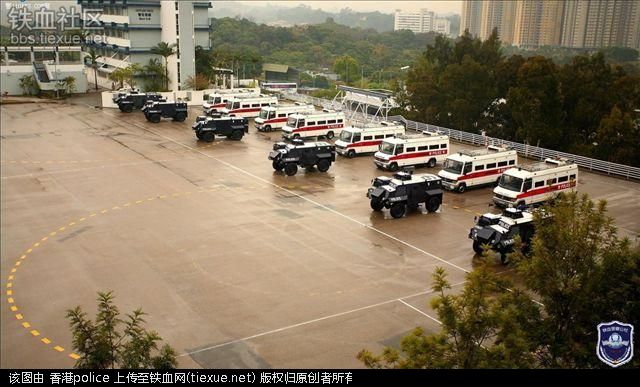
The reason you have not seen them in action is because parading in Fanling is the only thing they have done in living memory.

We must also note that the use of water cannons is fraught with dangers, to police/public relations and also to anyone who is unlucky with the water jet.

The reason why Boris’s purchases were never deployed in London is that the Home Office, at that time under the rule of Theresa May (yes, her) refused permission. She told MPs that exhaustive medical and scientific tests had suggested that water cannons could cause serious injuries including spinal fractures. Also it was considered that the deployment of such a weapon would harmfully affect policing generally.

We can here introduce Mr Dietrich Wagner, pictured with the white stick he now uses.

Mr Wagner is a retired engineer who participated in a demonstration in Stuttgart in 2010. He is not a radical: the protest was against a proposed development which would have involved the removal of a lot of mature trees.

Mr Wagner caught a water cannon blast full in the face. His eyelids were torn and some of the bones around his eyes fractured, causing his eyeballs to fall out of their sockets. He has had six operations on his eyes, and is still almost completely blind.

Mr Wagner is not the only victim of exuberant nozzle work. A 2013 report by the British government’s Defence Science and Technology Laboratory found “good evidence … to indicate that serious injuries have been sustained by people subjected to the force of water cannon”. Although water cannon are banned in the mainland UK they are used in Ulster.

A 69-year-old South Korean man died in 2016 as the result of a water cannon blast

In Zimbabwe three people died after the deployment of water cannons caused panic in a peacefully demonstrating crowd of 10,000.  During the Gezi Park protests in Turkey chemical-laced water loaded into cannons caused severe burns and eye injuries

In Indonesia, in 1996 “British-made armoured vehicles were used in a violent assault on a university campus, which resulted in many injuries and three student deaths.” The Independent reported, “Paramilitary police drove British-made armoured water cannon onto the campus and sprayed the students with an ammonia solution” causing dozens to suffer severe skin burns.

Last week a police spokesman told hk01.com that it may be better if usage instructions and deployment of the water cannons are left unknown to the public. Until the first inquest, maybe.

Well there is nothing really new in any of this. We have a government which spends money like a drunken sailor and a police force whose solution to every problem is more force.

Looking desperately for a bright side in all this I see that many WaWe’s in Germany compensate for their ample downtime by working for the local municipality as giant self-propelled watering cans in local parks. We do not have rolling acres of parks which need this sort of thing. But our threesome are going to be stationed in Fanling, just down the road from three golf courses. A happy coincidence. Keep those greens green.


Almost every day we hear that the citizen of the future must be a lifelong learner, that people will have multiple careers interrupted by periods of retraining, and indeed that the answer to the ills of globalization is to train workers for new careers if the industry they work in has been killed off by overseas competition.

Like so much of economics this seems to be based on a totally false idea of how people live and behave. A measure of job security, I suspect, is not some sociological ornament to be discarded in the interests of greater economic efficiency; it is a prerequisite for happiness.

This thought is prompted by reading “Janesville”, a new book by Amy Goldstein. I think I met Ms Goldstein once at a reception for winners of the Pulitzer Prize, of whom she is one.

Janesville is a town in Wisconsin, USA. It was the home of the oldest and largest car factory owned by General Motors. Curiously, it was for many years also famous as the home of the Parker pen. But who uses a fountain pen these days? The pen business succumbed to the competition of the disposable Biro years ago.

In 2008 the Janesville GM works closed. The town did not have much else going for it. Firms supplying parts to the car factory also folded. Thousands of people found themselves jobless.

This sort of calamity is of course not in itself unique. The last story I remember working on before leaving the UK was that of Consett, a town in County Durham gutted when its steel works closed. Earlier I had written a long feature about the plight of Millom, a beautiful little town on the coast of Cumbria similarly afflicted when its iron mine reached the end of the ore deposits.

While writing this I Googled Consett and Millom to see if they had recovered. They have not.

Ms Goldstein’s unique contribution to this depressing literary genre is that she kept in touch with Janesville and many of its inhabitants for five years. The result is a sort of non-fiction version of Albert Camus’s classic novel of human reactions to oppression, “The Plague”.

Adversity brings out different things in different people. Some fight, some flee. Some become more generous, some more selfish. Some are absurdly optimistic, others despair. Some reveal unsuspected qualities, while others discover things about themselves which they would rather not know.

Families also vary. Some disintegrate under pressure; some pull together. One of the most touching scenes in the book involves two teenage daughters working out how they can buy the family’s groceries with their part-time earnings, without humiliating their unemployed father.

The book is by no means consistently depressing. Readers who have been fooled by Americans’ self-description as a bunch of rugged individualists may be surprised by the amount of altruism and civic-mindedness to be found in an American town, even in these days of “Bowling Alone” and the collapse of the labour unions.

Readers who are accustomed to European-style social security systems, on the other hand, may be disturbed by the absence of the sketchy safety net which cushions this sort of catastrophe in a welfare state.

Ms Goldstein does not explore these themes. Indeed the book does very little for your opinion of politicians, who seem – regardless of party – helpless when faced with a social problem on this scale.

None of the usual suggestions offered to cushion the blow of technological redundancy seem to work out very well either.

Get on your bike and move is all very well for young things, for whom shifting to the nearest big city may be an attraction.  The problem for the older worker is that he owns a house. And in a town where the main industry has evaporated you cannot sell a house.

People who had worked years for GM did have the right of first refusal of any job which came up in the company elsewhere. So people took jobs in GM plants hundreds of miles away and became weekend commuters, a distressing fate for a family man and also rather expensive.

Retraining was offered on a grand scale. This was done with considerable care and enthusiasm by the local community college, which was expanded to cater for the new demand and undertook careful studies of which skills might be in demand.

Analysis of the results of this effort are disappointing. The people who completed courses at the college were slightly less successful in finding replacement jobs than the people who just went with what they had – in most cases a High School leaving certificate and years of irrelevant experience putting SUVs together. The retrained people also earned less.

In fact whether you look at the survey results or the anecdotal evidence it is clear that what happened to Janesville was bad news all round. The good old days were better, and have gone for good. Most people now still have lower incomes and their houses are less valuable.

The problem which the standard prescriptions overlook, I think, is that retraining in your existing profession is a help, and probably something you will volunteer, even pay, for.

Journalists in my age group started with typewriters and hot metal, gradually replaced by variations on the computer and now, for many of us, the paper edition itself has disappeared.

This is nothing new. Ernest Gann noted in the 1940s that although many of the pilots who had pioneered civil aviation in open cockpits in the 20s were still working in the business, most of the maintenance men of that era had disappeared. Unless they were prepared to study constantly the aeroplanes got too complicated for them. We all need to keep up.

Changing to another career altogether is another matter. If you become an absolute beginner in a new field, then you are going to get an absolute beginner’s salary and benefits. The idea that we shall all flit from career to career is a recipe for happy bosses and miserable workers. Which sums up the Chicago school of economic theory pretty well.

I suppose it would now be considered rather quaint to suggest that employers should accept moral obligations to the people they employ. How 1950s! Still I think the notion that the management’s only obligation is to the company’s shareholders is a nasty idea which appeals to nasty people.

Like most people in Hong Kong, I am now a Legislative Council representative short. In fact in my constituency we are missing two. This will continue until March 10, when a by-election will be held to fill some of the current vacancies.

That will be seven months after the first of my representatives to fall to the government’s political purge lost his last appeal. Seven months could be considered a long time.

The spokesman of the Election Commission, announcing the date, said that the government needed this long to train staff and arrange venues. This is puzzling, because the government has been running elections for a long time. You would think they had a sufficiency of experienced staff and a few voting venues lined up by now.

It is also puzzling because for many years our government managed to hold by-elections much more quickly. It is difficult to believe that staff have become harder to train or venues more elusive, but there has been a pronounced change in the speed with which Legco vacancies are filled.

Legco vacancies did not start triggering by-elections until near the end of the colonial period, so we can stroll through the whole history in a few paragraphs.

The first ever Legco by-election was caused by the resignation of Tai Chin-wah, in August 1991. The by-election was held on December 8 of the same year. A bit over three months, then.

This was improved on with practice. When Ng Ming-yam died in office on June 22 1992 his replacement was elected on August 30 of the same year, a smidgeon over two months later.

The last colonial by-election (for a geographical seat – I am ignoring the functionals, which ought to be easier) was caused when Lau Chin-shek resigned, over something which need not concern us here, in December 1994. The ensuing by-election was held on March 5 of the following year.

This suggests a norm, for a government committed to democratic practices, of two to three months, and indeed the post-colonial government kept this up for some time. When Chim Pui-ching landed on the “Go to Jail” square he was hoofed from the Council on September 9 and replaced on November 5, both 1998.

After the general election held on September 10, 2000, Cheng Kai-nam was found to have been a bogus solicitor for decades, and was persuaded not to take his seat. A by-election followed on December 10.

Ng Ching-fai resigned in July 2001 to undertake the more interesting task of being my boss at Baptist U, and the by-election was held the following September.

There is then a long gap, in which our election organisers seem to have got a bit rusty. When Ma Lik died in office on August 8 2007 the by-election was not held until December 10, a wait which had not been matched since 1991.

Worse was to follow. In January 2010 five councillors resigned with the intention of triggering by-elections as a “referendum”. The government did not approve of this, which may have something to do with a new record for sluggishness: the by-elections were not held until May 16.

The trend reached a new climax, or depth, depending on your point of view, when Ronny Tong resigned in June 2015 to prepare for a new career as a government poodle. The by-election was not held until February 28 of the following year, more than eight months after Mr Tong’s departure.

And this, it seems, is what the Election Commission would like us to regard as the new normal. This, I think, is not good enough.

Unconscionable delays in filling vacancies are bound to lead to suspicions of political tampering with what should be impartial work. If the current vacancies had been filled at the speed which was customary before 2010, readers will note, then the pro-Beijing group would not have been able to play games with the Legco rules of procedure as it has done.

To put it another way, one suspects that if six members of the pro-Beijing camp had fallen under a bus, or more plausibly been found to be using bogus qualifications, then the by-election would have followed with more traditional swiftness.

Hong Kong has an Electoral Affairs Commission which says “Its main objective is to ensure that the elections are conducted openly, fairly and honestly at all times.”
This is not achieved if by-elections are subject to arbitrary delays which are consistent with, if not caused by, attempts to manipulate the composition of the Legislative Council.

And the gentleman in charge of bullshit explanations about staff and venues should resign. Three months is long enough to organise a by-election. Any further delay is down to bias, inefficiency or idleness.


It is really far too early to make any sort of judgement on our new Chief Executive. Carrie Lam has only been in the post for a few months. There is time for improvement.

There is also cause for concern. The good lady seems to be quite unable to look ahead at the obvious consequences of her speeches.

Let us take Carrie on the co-location argument. Co-location refers to the government’s (or rather the Liaison Office’s) preferred solution to the question where passengers on the express rail link will go through passport and immigration control. Two floors of the station in Kowloon will become part of China for legal purposes, as will the inside of the trains, which is bad news if you were hoping for decent coffee.

More seriously it means there will be a permanent population of mainland officials exercising the powers to which they are accustomed on the mainland, located in the heart of Kowloon.

Many Hong Kong lawyers take the view that this plan is a clear violation of the Basic Law, our mini-constitution, which states quite explicitly that mainland laws, with a few named exceptions, will not apply in Hong Kong.

Supporters of the plan say that decisions of the National People’s Congress Standing Committee have the status of laws, and being laws of China they over-ride laws which are merely laws of Hong Kong. So you colonial subjects can suck it up and stop complaining.

Ms Lam has not been in much involved in this discussion but she waded in the other day in response to a formal statement from senior members of the Bar Association. who complained that the proposed arrangement was a serious erosion of the rule of law.

This was a tackle of the kind once associated with Norman Hunter: never mind the ball; get the man.

The Bar Association, said Ms Lam, was elitist. Why elitism should be regarded as a weakness in this context she did not say. Presumably elitism does not impair legal reasoning, so this was not a very relevant comment.

But it invited the rejoinder, which was not slow in arriving at those parts of the internet where critics of the government gather, that Ms Lam was hardly in a position to criticize elitism in others. One of her less prestigious claims to fame is that when running for selection she turned out to so addicted to chauffeur-driven travel that she could not get through an MTR turnstile without help.

Ms Lam’s other beef with the Bar was that they were “showing contempt for the mainland legal system”. This is another non-argument. Someone who feels contempt for the mainland legal system – me for instance – is not thereby precluded from arguing that some action is legal or illegal.

Of course if you take the most depressing view of the mainland legal system – that the law is whatever the Party thinks it is at the time – then contempt may perhaps be justified. Co-location is effortlessly legalized. But that is not a legal system at all.

It has been interesting to watch the two competing views of legal matters generally in the last few months, because the contending parties have switched sides.

Six months ago pro-China commentators were emphasizing the full and unrestricted power of the mainland government in Hong Kong, while more localist writers pleaded for respect for the limitations specified in the Basic Law, the Joint Declaration and other scraps of paper.

Now local lawyers are complaining that the Beijing government is all over us, dabbling in everything, and pro-China commentators argue that there are limits, and those limits are being observed.

The other day, for example, the China Daily had a piece by someone called Xiao Ping (a pseudonym. I suppose, selected by an admirer of the late Deng) pointing out at some length that “overall jurisdiction” and “a high degree of autonomy” are not mutually exclusive, which I thought was my line.

Mr Xiao (or Ping) goes on to argue that it is misleading for people to write as if Hong Kong was to be entirely autonomous in everything except defence and foreign affairs. He points out that the central government has the right to appoint the Chief Executive and the NPC has the right to interpret the Basic Law.

This is true. And if the central government confined itself to such matters we would not be having this argument. The fact is that there is a short list of officials who need appointment by the central government, but the Liaison Office does not confine its meddling to those posts.

Indeed every time a CE forms a new cabinet we get two stories. One states that X and Y have been offered posts and refused. The other states that W and Z were selected and agreed to do the job, but their appointments were vetoed by the Liaison Office.

Well it would be surprising if I completely agreed with Mr Xiao, whoever he is, and the constitutional arguments will no doubt continue. I am less happy with his conclusion, which appears to be some kind of threat: “As for those spreading lies about overall jurisdiction and high degree of autonomy, they will get burned if they don’t stop playing with fire now.”

What is that supposed to mean, one wonders? Something like it is a common trope in pro-Beijing writing. It seems that Junius Ho is not the only Hong Kong person in whom the contemplation of the glories of communism awakens an inner thug. In the continuing search of a harmonious society, could we not all agree at least to refrain from threats of violence?


Some months ago the Lands Department, the Hong Kong Government Department which presides over land use, came in for a certain amount of stick concerning the ease with which some people mysteriously acquired the free use of bits of government land. Sundry houseowners (this seems to be a disease of the rich) had managed to establish such facilities as swimming pools and tennis courts on said patches. The department, beset by much other work no doubt, had failed to assert any control over the matter.

Part of the department’s response was to upload to the internet a map, which you can see here — http://www2.map.gov.hk/gih3/view/index.jsp — offering some 300 “Vacant Government Sites Available for Application for Greening or Government/Institution/Community Uses”. The implication is that NGO’s might find a use for a site, and apply to the department to borrow it. Apparently the question of rent will not arise – the idea is to put idle assets to good use.

This looked interesting. I have for some years longed to find an abandoned and inexpensive place where several arts groups of which I am a member could have a permanent home: a place to store their stuff and practice. I know of several arts groups which have gone out of business because of the lack of such a place. Others have to rely on public provision, for which the competition is fierce. Also you cannot book anything on a long-term basis. As a result my dancing career has taken me to a wide variety of community halls and sports centres which I did not know existed. The idea is not to open a performance venue, just a couple of biggish rooms for regular practice sessions.

The Lands Department’s map is searchable and the offerings come in two categories — vacant school premises and “others”. It seems from the sample I have looked at that the others are mostly odd-shaped pieces of land currently occupied by grass and trees, which the department thinks someone might enjoy “greening”. In other words, no buildings. As far as the vacant school premises are concerned there are none in the urban area at all. It is difficult to believe that the provision of schools has so exactly matched requirements. Not one vacancy in the urban area?

Never mind. I am broad-minded and I live in Shatin. In my district the department is offering three “vacant school premises”. Two of them are in the middle of nowhere. One is at the back of an inaccessible village. One is actually in an area which appears on Google earth to be entirely forested and have no houses at all. I suppose there was a village there once. Also lacking is any kind of road. It’s miles from civilisation. The third looked more hopeful.

This is described as “near Lung Hang Estate”, which suggests accessibility, and indeed on the map it appears to be a short walk from Tai Wai Station. So I thought before considering a visit to the local Land Office I could have a quick look and see what was on offer. The site is, as I surmised, a mere 10 minutes walk from Tai Wai station. You go down an alley between two schools. You then come to a rather handsome fence, through which you can see a lot of tombs and urn repositories. The fence has a gate. Although this sported two padlocks neither of them was actually locked so I pushed the gate open and went in.

There is a flight of steps, which I correctly guessed would lead to the school. They are small (meant for kids?) and rather neglected. Lots of rubble. Who builds things up here?. I came to the remains of the school gate – two concrete pillars and, lying on the ground, an arch with Chinese characters in wrought iron, now turning into wrought rust. Then, on the left, a flat patch which presumably used to be the playground. This sported a row of brandnew tombs, which solves the building mystery. Onwards and upwards and a building appears. Monkeys fled at my approach and several bits of tree had to be pushed aside. So to the “vacant school premises”, which turned out to be a picturesque ruin. A few more or less intact walls and some reminiscences of a roof. The department’s website notes the existence of “derelict structures”, an understatement.

I do not like to appear unwelcoming of a well-intentioned innovation, but NGOs tempted by the thought of a vacant government site need to keep two things in mind. The first one is that a “vacant school building”, if you can find one near you, may not be much of a building. In fact it may be more of a wreck. The second is that the vacant site may not be all that vacant either. I fear that anyone who takes up the offer of a vacant school near Lung Hang Estate is going to be very unpopular with the local tomb industry, which has evidently become accustomed to using this site for its own purposes. It seems the Lands Department does not actually have much control over what happens on vacant sites. Which, alas, is where we came in.

Walk down any street in Tsimshatsui and a man will offer you either a copy watch or a suit.

Well we all understand what a copy watch is. Probably we all understand what a suit is as well. This is an unremarked landmark in the success of cultural imperialism.

The other day I was looking at one of the numerous pictures of the latest festivities in Beijing. Every member of the new leadership – there are reportedly some women there but they had eluded the cameraman – was wearing a black or dark grey suit: jacket, three buttons. Trousers, down to top of feet. With a white shirt and a tie, colour of tie the only thing according to individual taste.

Look at a picture of President Trump on the campaign trail, or in a cabinet meeting, and you see the same thing on every man present: suit, tie, white shirt… The only difference is that the Americans have more variety in hair colour, led by Mr Trump’s notorious yellow follicles.

In Beijing hair is worn black, despite the rather high average age. There is a curious symmetry here. On porn sites there are an implausible number of blondes, in bulletins from the Politburo an implausible number of ravens.

The depressing thing about this is that you actually see more variety in a British Army infantry school passing out parade. They have the same guns, the same uniforms, but at least the graduates wear the hats of the unit they are going to join, which produces an interesting variety of caps, berets, and strange Scottish headgear.

It is difficult to believe that a society, whether Chinese or American, can be a hotbed of originality and innovation if its leading members, as a matter of course, all wear the same uniform.

The lounge suit, as it is officially called, is one of the few inventions which has not been claimed by Chinese historians. People who take an interest in this backwater trace its origins to Charles II, the Merry Monarch or the Harvey Weinstein of the 17th century, according to taste.

In 1666 Charles, following the example of Louis XIV, instituted a dress code for gentlemen at court (that is the Royal court, not the tennis court or the legal one) which comprised knee breeches, a coat, and a waistcoat. Gents were also required to wear a cravat (a now extinct variation on the tie) and a hat.

It seems sober gentlemen got in the habit of having the three pieces in the same colour though this was certainly not compulsory.

The other person who shares the blame for the modern suit is Beau Brummel, the dissolute but very fashion-conscious side-kick of the Prince Regent, later George IV. I must say that pictures of Mr Brummel do not look much like modern suit wearers but apparently he more or less invented trousers which came down to the ankle, as opposed to the previously customary knee breeches.

Something we would recognize as a suit appeared towards the end of the 19th century, initially as sporting wear. By sporting we mean aristocratic sports: shooting and fishing, nothing too athletic.

By the end of World War 1 the “lounge suit” had become the standard wear for men of all classes except the very rich, who persisted in such interesting oddities as the tail and frock coats.

In the second half of the 20th century there was a general movement on the part of people previously considered toffs to stress their sympathy with the general public by wearing the same clothes. So a high level of uniformity was achieved and if you look at pictures of crowd scenes, whether at sporting events or factory gates, weddings or funerals, most people are wearing the suit.

For me this came a bit unglued in the 60s. Like most people who went to boarding schools I had been required to wear a uniform which was clearly intended to prepare us for life in a suit – trousers with crease, blazer, white shirt, school tie…

When I went to university I supposed that people would wear a civilian version of this, involving maybe what was called a sports jacket (a tweedy thing you wore with non-matching trousers) and perhaps a cravat, which survived in those days as a comfortable alternative to the knotted tie. To my surprise a lot of people managed quite well in jeans and a sweater so after my first term I joined them.

We now have a paradox: lots of people wear suits to work. Nobody would dream of wearing one at the weekend unless they were going to church, and perhaps not even then.

One of my lady friends observed on this topic that “anyone who is wearing a suit is in sales.” The rest of us are free.

And what do we do with our freedom? We develop another uniform. I have every sympathy for Mr Howard Lam, the politician who may or may not have been abducted by mysterious assailants who stuck staples in his legs. Clearly Mr Lam either had a very nasty experience or needs some heavyweight head help.

I could not help thinking, though, observing still pictures of the video which allegedly showed him walking through Mong Kok unkidnapped, that there must be a great many similarly dressed men in Hong Kong.

He was wearing long shorts in dark blue or black, a dark tee-shirt, black peaked cap with logo, trainers and a black rucksack. I have every one of these. The thought occurred to me (bad taste warning) that if I was short of a Halloween costume I could assemble my shorts, tee-shirt, cap, rucksack and trainers, draw a few crosses on my legs and go as Mr Lam.

In one of C.S.Forester’s Hornblower books (well OK it’s The Commodore; I know the Hornblower saga backwards) the hero muses on the burden presented by civilian life, where he has to choose his clothes, and take the blame if they do not suit him. Wearing the King’s uniform was less stressful, because whether it suited him or not there was no choice involved.

It seems that ladies cannot avoid this problem. You are judged by what you choose to wear. In my trade union official days aspiring lady officials wore men’s shirts and jeans, flat shoes and no make-up (the Rosa Luxemburg look?) but this clearly suited some people much better than others.

Men on the other hand can avoid this problem by tacitly agreeing that they will all wear the same thing. Which is what we do whenever we can. Whether this is mere laziness or reflects some inherited tribal instinct I leave to the scientists.


An autocratic police state run by a centralized dictatorship. A multi-ethnic empire imposing its chosen language on administration and education, trampling local dialects.

A variety of different administrative arrangements, rights and privileges in different regions, with defence and foreign affairs strictly reserved for the central authorities. Functional constituencies…

Before you jump to conclusions, I have been reading “The Hapsburg Monarchy, 1809-1918”, by A.J.P. Taylor, a history of what became the Austro-Hungarian Empire. The book is almost as old as I am – it was first published in 1948 – but Mr Taylor was a noted stylist whose prose still gives pleasure. I wonder if the same will be said of the contemporary historians who, now that he is safely dead, are rather rude about him.

The story told here is a depressing one. It starts with defeat by Napoleon, and ends with Austria starting the First World War and disintegrating under the strain of defeat in it.

Beijing officials will not perhaps welcome the suggestion that, having rejected Stalin’s empire as a model, they should turn to Franz Josef’s. It isn’t exactly a shining example. Switzerland is erroneously accused (in The Third Man) of producing nothing but the cuckoo clock. What can we attribute to Vienna but a lot of classical music and some lovely pastries?

Well try this, in the account of the achievements of the “German liberals”, who briefly enjoyed a period of political prominence before normal aristocratic service resumed in 1871: “They thought it was the duty of liberalism to protect the individual from the state and could not imagine a state under popular control, least of all under their own.”

And yet “These constitutional laws … created a system of individual freedom… There was equality before the law, civil marriage, freedom of expression, freedom of movement…

“The police state still existed … but it was a police state exposed to public criticism and confined to civilized behaviour.”

“Political affairs were discussed without restraint, and the German Austrian, at any rate, felt himself free.”

Now there are no exact parallels in history, and there is clearly one topical item missing here. The German liberals, because they spoke the imperial language as their mother tongue, had nothing to say about the language question, which was a live issue in most of the Austrian empire, where people spoke a wide variety of mother tongues.

Also you could say that the Hong Kong liberals approached this from the other direction. Our pioneers hoped that democracy in Hong Kong would lead to democracy in China. Contemporary localists do not imagine a state under popular control and see democracy only as a way to protect the individual in Hong Kong from the state in Beijing.

Clearly though there is an outline here of a sort of grand bargain which might, as it did in Austria, deliver several decades of comparative peace and freedom, though it will probably have to wait until the regime in Beijing, which is very full of itself at the moment, has suffered a painful collision with economics.

A lot of Hong Kong people would be prepared to settle for the rule of law, freedom of expression, freedom of movement and a “police state exposed to public criticism and confined to civilized behaviour.” Nobody really wants to dabble in defence and foreign affairs, or for that matter in the numerous and difficult problems presented by the internal affairs of the rest of the Chinese empire. They want to feel free here.

If this was consistent with absolute monarchy in Vienna there is no reason why it should be inconsistent with “China’s absolute sovereignty” over Hong Kong. It just needs people to get their heads round it. Is there anyone in Beijing who can even spell “self-restraint”?

Observant readers will have noticed that I missed out one of the achievements of the German Liberals, the arrival of “civil marriage”. This was one aspect of the resumption of secular control over the Roman Catholic church. This is generally regarded as an exotic European problem of no relevance to Hong Kong, but I am not so sure. Hong Kong, as one observer put it long ago, enjoys freedom of religion but not freedom from religion.

This brings me to the matter of the Gay Games and the government’s tepid response to the news that this festival is coming to Hong Kong. Every columnist in Hong Kong has lambasted the government’s approach to this matter already, so I shall be brief.

If Carrie Lam feels that presiding over a festival of pink power is inconsistent with her religious beliefs nobody could complain if she sent someone else to do the opening ceremony. Not C.Y. Leung, please.

The question of how the government should handle the games, however, is not a matter of personal conscience, it is a matter of public policy. And the relevant public policy is that hosting mega events is good for the economy and the territory’s reputation so they should be supported with encouragement, money and help with booking venues.

This policy should not be abandoned in deference to the views of a minority of Godbotherers, even if the Chief Executive happens to be one of them.

Usually when an international story about human behaviour appears we are treated, sooner or later, to a local version. So far though, the current fashion for complaining about the sins of Harvey Weinstein and other male pigs has not prompted any Hong Kong victims of harassment or worse to come out and tell their stories.

We can safely exclude the possibility that this is because there is nothing to tell.

Hong Kong had a world-class film industry, and it had a world-class casting couch habit as well. If anything, it seems, the situation was and is worse here, because standards of behaviour are lower.

Mr Weinsten may be a man with whom no woman is safe, but at least he is not a gangster. The Hong Kong film business has long been a popular money-laundering machine for people with what newspapers in countries with English-style libel laws call a colourful background.

As a result female actors are expected to be athletic and sociable not only with the producer but with his sundry friends and financiers as well. This toxic culture only occasionally surfaces in public. It is occasionally alluded to in print in a rather indirect way if a young actor commits suicide.

Otherwise we get the occasional accident. There was the case of the well-known TV personality whose method of expanding his social circle was to promise potential bed partners an audition. This only came to light because one of these partners, possibly suspecting that the glittering career did not beckon as advertised, had an accomplice emerge from the wardrobe with a camera in the middle of the proceedings.

The upshot of this was that she and the camera person were charged with blackmail. The star of the show was allowed complete anonymity by the court..

Then there was a case which involved dangerous driving. The driver, who was running a TV station at the time, had been celebrating an agreement to buy advertising. The buyer appeared in court with an implausible tale of how much they had not been drinking and explained the deal, which included the interesting provision that the casting of all the female parts in the show to be sponsored should be done by him. Why a young millionaire with no relevant experience was given this job was not explained.

Then there was the time Mark Thatcher, son of the famous Margaret, came to Hong Kong as the guest of some of the less puritanical parts of the financial industry. They were looking for a reputable international face and he was looking, I suppose, for some money.

However this story, which was mainly about business, took an interesting turn. One of the less puritanical parts had a showbiz connection and Mr T spent an evening with a quite beautiful young actress who was, I suppose, on their books. We tracked them through dinner and disco. What happened after that remained unknown. Clearly the situation was rife with possible misunderstandings.

Readers who have been around for a while may also recall the case of a magazine which printed on its front cover a picture, heavily pixillated, which was allegedly of an actress who had been kidnapped and beaten up a few years before. This led to noisy protests from showbiz people at the publication of the picture. The prevalence of kidnappings and beatings in their industry, on the other hand, apparently did not call for comment.

We must not, I suppose, suggest that the entertainment business is the only one with this problem. Factories and other work establishments employing large numbers of women present obvious opportunities for abuse of power.

So, I fear, do educational establishments. There are two schools of thought in local universities. One holds that students are adults and if they want to socialize or sleep with profs that is their decision. The other holds that this is a dangerously asymmetrical situation full of dire possibilities and should be avoided.

Personally I prefer the second view. But that is easy for me, because by the time I got into the business I was a happily married man old enough to be the average student’s father. Those who take a more conventional approach to academic work face a long period in which they are neither purely a student nor completely a professor. This is unsatisfactory for a number of reasons, of which the danger of romantic misunderstandings is only one.

Well we shall see. I suspect it will only take one example to unleash a flood of stories. But Hong Kong is not as kind to whistleblowers of all kinds as … say, the US. I am not sure, if I had a daughter who was considering being that one example, whether I would encourage this, or not.

Let us hope, at least, that we shall not see much of that weasel word “inappropriate”. Good behaviour and bad behavior we all understand. “Inappropriate” sounds like an etiquette problem, like using the wrong fork for your fish or wearing a hat in church.

Most of the behaviour which people are complaining about is not impolite; it’s criminal. Forcing people to have sex with you is rape. Grabbing their private parts is indecent assault. Grabbing other parts is assault.

I realize that there are marginal cases where two people may have different views of the situation. Indeed the import of an action depends on its context. I had a lady colleague of considerable beauty on a Hong Kong newspaper who was often patted by the editor. There was nothing explicitly erotic about it. He patted her shoulder. She didn’t like it, didn’t complain, and eventually left. Clearly this would now be regarded as objectionable

On the other hand I had a colleague in a local university who occasionally patted me. This was also on the shoulder and I did not take it as an erotic invitation. I was a bit disconcerted the first time – do I look like a dog? Apparently this lady regarded me as a large and potentially fierce animal.

But then some writers maintain that this is the world women live in; they permanently share their space with larger, stronger and potentially fierce animals called men. Soothing massage is a survival skill.

This brings us to another delicate area, which is the question of consent. The Economist opened its discussion of Mr Weinstein’s alleged crimes with this quote: “I spent a great deal of time on my knees,” Marilyn Monroe once said of how she became a film star. “If you didn’t go along, there were 25 girls who would.”

You have to wonder what was going through the minds of all these young things who turned up for an evening “interview” in Mr Weinstein’s hotel room. After all this is not a promising venue. Generations of Hong Kong reporters have been told, by me, never to agree to an interview in a hotel room. Temptation lurks if you are alone in a small room with a bed and a person of the opposite sex, or in these liberated days with a person of the same sex if that is your preference.

There was an amusing piece in the Guardian the other day by a lady who accepted the Weinstein invitation but turned up with a chaperone. The “interviewer” was angry and the “interview” extremely short.

Mr Weinstein’s proclivities were in fact well known. I have a friend in Hong Kong who, in his prime, was notorious for his, shall we say, hearty sexual appetite. I once asked him if this bothered him. On the contrary, he said, he treasured it because it meant that if a lady accepted an invitation to his flat she knew what was likely to happen later. She might refuse his advances but she would not be shocked by the approach.

I do not suggest that we should blame the victims in any way. But I do wonder if some of the people who now claim to have been shocked by Mr Weinstein’s actions were, at the time, willing to pay an unsavoury price to further their careers. They shouldn’t have been asked for it, of course, but Ms Monroe was surely not the first, or the last, to feel that this was the way the business worked.

The times are now a-changing in Hollywood. Are they changing here?

I am an enthusiastic amateur cook. After many years of managing with a variety of recipe books I discovered a great deal of inspiration on Youtube. Famous chefs here strut their stuff, and this brings us to the matter of the Michelin Guide, or if you pronounce it in French with the adjective after the noun, the Guide Michelin.

This dates back to 1900, when the owners of the Michelin tyre company, in an effort to increase demand for their product, started publishing an annual free guide to petrol stations, garages and hotels. In due course this became a paid-for publication, and developed a speciality in reviewing restaurants, which it still does today. The guide now comes out in the form of a little red book, and grades restaurants in three categories:

One star: “A very good restaurant in its category” (Une très bonne table dans sa catégorie)

Two stars: “Excellent cooking, worth a detour” (Table excellente, mérite un détour)

Three stars: “Exceptional cuisine, worth a special journey” (Une des meilleures tables, vaut le voyage).

The annual appearance of the guide now attracts, at least in France and the UK, the sort of industry and media attention which attends the Oscars. Chefs take very seriously their star status and in at least one case the constant struggle to keep three seems to have led to the suicide of the cook concerned. For a detailed video tour of the scenery there is an hour-long piece of BBC here: https://www.youtube.com/watch?v=0f-j1ctaQqw

Let us just say (for we have to get to the local angle soon) that the guide has attracted a certain amount of controversy. Some restaurants have asked not to have stars, either because a star produced a surge of demand which overwhelmed the successful chef, or because it led customers to expect a sort of “fine dining” to which the restaurant did not aspire. Marco Pierre White, who despite his exotic collection of Christian names comes from Yorkshire, tried to give his third star back. Explanation here: https://www.youtube.com/watch?v=U-xCIstDBaI&t=5s at 44 minutes. Raymond Blanc (who has a whole Youtube channel to himself and deserves it — see https://www.youtube.com/user/TheRaymondBlanc) is quite happy with two. Jamie Oliver, a name to conjure with and the owner of a fleet of successful restaurants, has never had one (though he does have an MBE, and sundry other awards). The identity of the guide’s anonymous inspectors is a closely guarded secret, but one disillusioned former inspector went public with the complaint that some of the things the company claims – for instance that candidate restaurants and existing star-holders are reviewed repeatedly – are not true. Well French people take this stuff seriously.

And not only French people, it seems. A little row has been bubbling along in America about the coming and going of various cities which have had Michelin guides of their own, and then did not have them. It then emerged that to have a Michelin guide published about your city you pay the publisher a fee, which they politely call a commission. You do have to offer a reasonable number of restaurants for them to inspect, but they do not take the initiative. You cough up the money. No money, no guide. In the course of this miniscandal the Michelin people pointed out that “The guides in Seoul, Macau, Hong Kong, Bangkok and Singapore were all commissioned”. Were they indeed?

I don’t know what the people in Seoul, Macau, Bangkok and Singapore think about this, but it seems rather a curious use of Hong Kong’s public money, even allowing that the government has more of it that it knows what to do with. Also I seem to remember that when the Michelin guide to Hong Kong first appeared we were told, by people who should have known better, that this was a tribute to Hong Kong’s status as a culinary capital, an acknowledgement of the extraordinary quality and diversity of our food landscape. No it wasn’t. We just bought it.

According to a local food blogger called e_ting (get it?) he had some suspicions about this and specifically asked the Tourism Board in 2014 if it had any involvement in the genesis of the Hong Kong guide. The Tourism Board’s reply (which would have struck me as suspiciously detailed) said that the Board denied “any lobbying of Michelin to come to HK, any influence over restaurant selection, inspector and restaurant nomination, and rankings in any way”. The possibility that the Tourism Board had financed the whole enterprise was not mentioned. Mr ting now feels with some reason that this was not as illuminating an answer as it should have been, and wonders if – now that Michelin has let the cat out of the bag – we shall hear from the Tourist Board.

Perhaps we shall, Indeed I can practically write their answer now. “Encouraging Michelin coverage a legitimate activity to boost tourism … valuable publicity for Hong Kong … draws attention to a seductive local attraction etc. etc.” Well certainly the Board uses the Michelin material on a generous scale, as for example here: http://www.discoverhongkong.com/eng/dine-drink/dining-events-awards/michelin-guide-awards/index.jsp

You have to wonder two things, though. One is why, if this was such a good idea, the Tourism Board has been so slow to claim credit for it. The other is whether this is really a practical way of increasing tourist numbers. Hong Kong tourists generally come from a long way away. The more affluent, the further. We have six restaurants which are, apparently, “worth a special journey”. But that means an hour or two driving across the French countryside. Are people really going to fly into Hong Kong for the pleasure of paying spectacular prices for what is, after all, in the end only food?


Well for once I am sorry I missed “Straight Talk”, a TVB programme on which crumbs from the upper crust are obsequiously interviewed. Chief Executive Carrie Lam was the star on Tuesday, and warmed by the studio lights and the atmosphere of fawning adoration she was interestingly revealing.

When she thought she was retiring last year (you remember that bit, before C.Y. Leung was promoted to a non-job in Beijing) she discovered, apparently, that she “could not afford to buy a flat in the urban area”.

She could afford “only” a three bedroomed flat in the New Territories, costing $15 million. Unfortunately for the vendor of this palace Ms Lam then discovered that as the Chief Executivette she would have the free use of Government House for five years, so the deal fell through.

Meanwhile, prepare a tissue for this bit, “When I quit the civil service and joined the principal officials, my lump sum pension was only a mere $7 million,” she said. A mere $7 million. Did angels weep?

Let us leave aside the possibility that a great many people in Hong Kong would be deliriously happy to have $7 million. Let us leave aside also the observation of some close observers of the local real estate scene, that you can actually get a three-bedroom flat in the urban area for $15 million. Maybe the lady is fussy.

What viewers may have missed here is that Ms Lam’s pension entitlement is a complicated matter. When she quit the civil service she was 50. It is usually considered inconsiderate, if not rude, to reveal ladies’ ages but Ms Lam’s date of birth is the first item on her Wikipedia page so that cat is already out of the bag.

The official minimum retirement age for civil servants under the Old Scheme (the arrangements for more recent recruits are less generous) is 55. So until you get to that age you are not entitled to a pension in the sense of regular monthly payments at all.

You are however allowed what the Civil Service Bureau calls “commutation”, in which you exchange some of your future pension entitlement for a lump sum now. This goes up to 25% – again the later arrangements are different – so that is where the $7 million came from. In other words it was not Ms Lam’s “pension”, in the usual sense of the word. It was the result of cashing in a quarter of the pension early.

At the end of C.Y Leung’s first term Ms Lam was 55 (consider my excuse repeated) and so she could expect her pension to start. As the CSB web site puts it in impeccable bureaucratese: “Under the current pension suspension policy, if a pensioner is re-employed to the Government, e.g. as a non-civil service contract staff, the payment of his/her pension may be suspended during his/her service of re-employment unless and until he/she has reached the applicable normal or prescribed retirement age under the relevant pension legislations.

Ms Lam is now receiving the pension, and the CE’s salary. This is a fairly mind-blowing thought. It used to be said that the Chief Executive of the Hong Kong SAR received more than any national leader except the Prime Minister of Singapore. Have we now overtaken Singapore in this dubious steeplechase?

Well no doubt Ms Lam has earned her good fortune, and may consider it a poor reward for the abuse which will come her way if she keeps parroting the Liaison Office line. Still I think she should consider carefully before giving the impression that she deserves sympathy for her housing problems.

Ms Lam owns no property in Hong Kong because, as the SCMP put it,  “she had been living in government quarters since becoming a civil servant.” In other words between 1980 and 2007 she was spared the need to pay for accommodation at all. She was also entitled to an education allowance for the kids, and the free medical and dental services provided for civil servants. In the later stages of her career she could also save on travelling expenses by lavishly abusing a government car, as all Hong Kong’s senior civil servants do.

Then we have five years as a top political appointee, which is generously rewarded and also attracts a great deal of free food. If Ms Lam is short of a bob or two she hasn’t been concentrating. I notice also that the question of property in the UK, where her family lives, did not come up. A pity.