Another day, another embarrassing story about Hong Kong. Our city has become a dangerous place for independent bookshops. Secretary for Security Chris Tang says his forces are not targeting any particular sector. Indeed. Only three boookshops have been raided so far this year.
So independent bookshops have just been unlucky. Well we have to believe officials when they say these things. They are honourable men. So are they all, all honourable men…
One does rather cringe, though, at the idea of newspaper readers all over the world seeing the picture of a bookshop staff (teeshirt: I am a bookshop staff) being led in cuffs out of her workplace. Quite apart from the distressing thought of a young woman being led off for trial on dubious charges, why do our national security police look so scruffy?
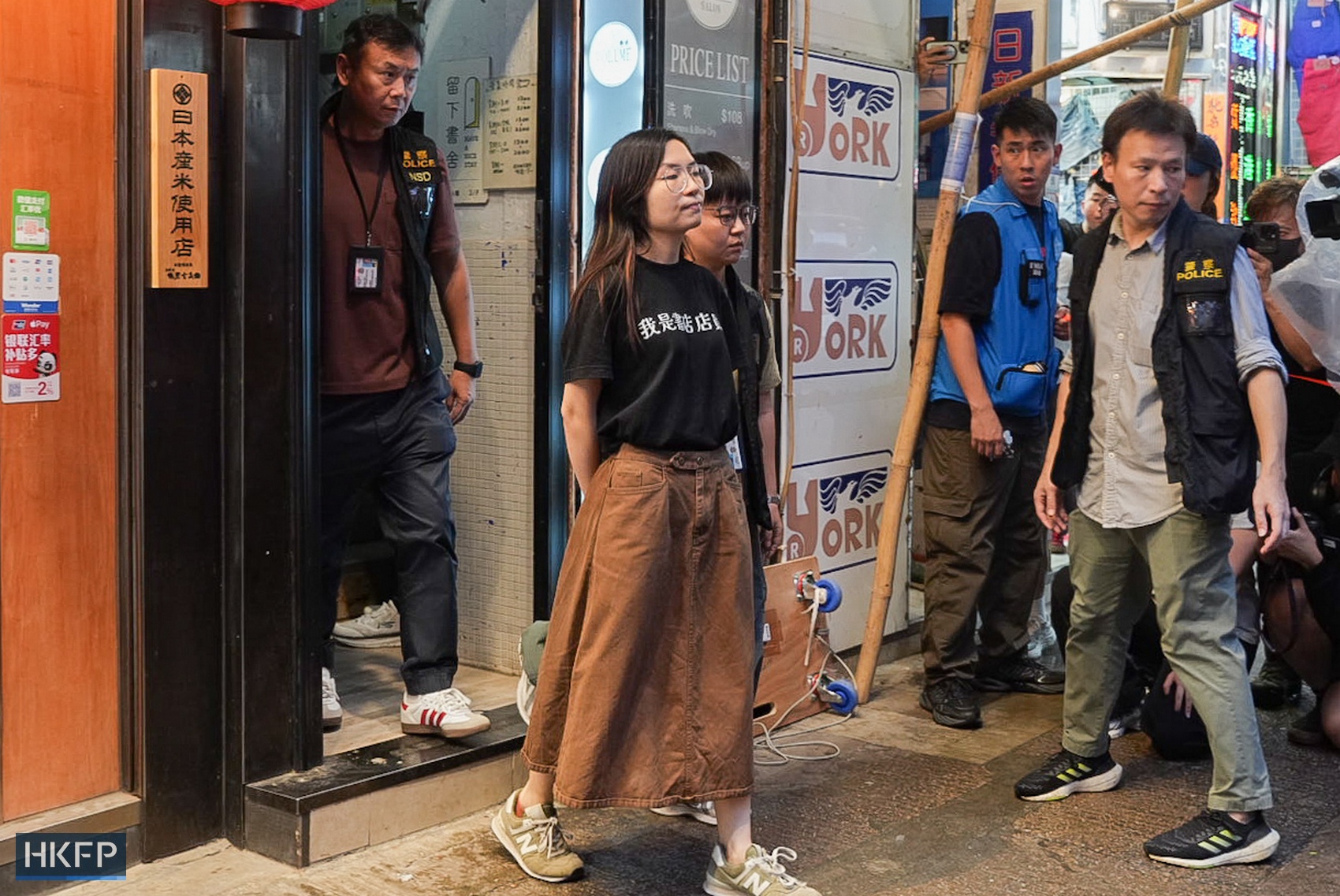
I suppose there may be some reason why raids on delinquent bookshops cannot be done by cops in full uniform, but if there are to be plainclothes could you boys at least tuck in your shirts, and maybe iron your trousers? I also have some misgivings about the Adidas product placement.
Mr Tang, meanwhile, continues to spout nonsense. Booksellers must be responsible for the books they sell, he says, “just like merchants selling food have to make sure their food won’t make people sick. That they are not selling poison and not breaking the law.”
This is a totally false analogy. Someone selling food has complete control over the situation. The cafe owner or chef chooses the ingredients and the preparation method. It is entirely right that he or she should be held responsible for not poisoning people.
Someone who runs a bookshop does not write the books. I find it hard to believe I had to write that. Unless the bookshop is vanishingly small the person running it does not even read the books. This is simply not possible. Some books are very hard work. Is “War and Peace” subversive? Don’t ask me; I have never managed to finish it. It is not the philosophy that loses me, but the fact that in Russian novels every character has at least three names.
It is interesting to compare Mr Tang’s hardline approach with the law on obscene publications, passed in gentler times, which provides a defence for people who “had no reasonable opportunity to inspect the article the subject of the charge; and had reasonable grounds for believing that article was not obscene.”
After all there is no reason to suppose that people who work in bookshops are bent on breaking the law. I imagine a polite notification that a particular book was, in the official view, subversive would result in the swift disappearance of the denounced volume. This would be sad, but not as sad as losing the whole bookshop, which seems to be the government’s objective.
Mr Tang rejected suggestions that it would be useful to supply booksellers with a list of banned works, saying that this would only “help criminals”. This seems an odd thing to say. After all it is generally considered a good idea that people should know in as much detail as possible what is the law which applies to them.
We do not see signs on our streets saying “Speed limit: guess!” or “Possibly no parking”. Providing a list need not imply that anything not on the list is legal. It would simply provide guidance to book vendors trying to work out what is allowed and what is not.
Mr Tang’s other objection to a local Index Librorum Prohibitorum (the name of the Papal version, abandoned in 1966) is that people producing banned books could simply change the title of the book. This is so far off the mark as to suggest that Mr Tang’s encounters with literature have been quite limited. The title of the book is its name, the label by which the eager reader identifies it.
If we change the title to hide the book from Mr Tang’s minions, we also hide it from potential readers.
What is really worrying nat sec enthusiasts may be the thought that a list of forbidden books would provide good publicity for some otherwise obscure works, and people with a taste for subversive literature could order copies from overseas booksellers. Books you cannot buy from shops in Hong Kong might soar up the Amazon bestseller lists.
This is not a totally implausible fear; “The one they tried to ban” has sold a lot of books. But what does that tell us about the relationship between Hong Kong’s government and people?


Another excellent one Tim! Thanks for putting it into words, I’m afraid the honourable Mr Tang doesn’t quite have the depth to work these things out himself.