In 19th century revolutions the usual procedure was for the insurgents to build barricades in working class districts and fight pitched battles with the forces of order, a process idealised in paintings (see below) and poetry. If the forces of order were defeated you then went on to storm the Bastille, Palace or whatever.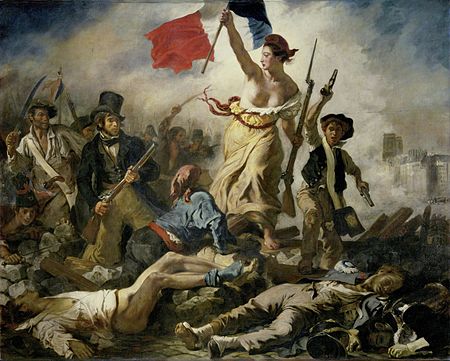
In the 21st century this is no longer a realistic ambition. Advanced societies cannot be physically brought to their knees by anything that happens on the streets. The people are outgunned. On the other hand governments depend on the consent of the governed in a way that traditional autocracies did not.
This leads to the paradoxical result that the aim of protests, however exuberant or destructive of property, is not to inflict violence, but to provoke it. The merits of the protesters’ cause are reinforced by the impression that state power is being abused to suppress it.
Unfortunately our police force, though wonderful in many ways, is disastrously easy to provoke. When it was decided that CS gas, which is banned for military use, could be issued to police forces the justification was that this would give them a weapon they could use when they would otherwise have to open fire with real guns.
So the fact that it was fairly poisonous is acceptable in other countries because the alternative would be more dangerous. In Hong Kong, though, tear gas is not an alternative to deadly force. It is an alternative to thought. After a gathering of 100,000 or more people, whether for a rally, a race meeting or a football match, there are bound to be crowds milling about in the streets, especially if the bus and MTR stations are closed. Treating this as an unlawful assembly stirs up unnecessary trouble.
However lessons are being learned. Protesters and police alike were making notable efforts last weekend to appear the least violent parties to the conflict, a nice change.
This left the current propaganda campaign from our imperial masters looking a bit phony. We were invited to believe that high levels of violence were being deployed, and indeed that the situation verged on “terrorism”.
This was never very convincing. “Violence” covers a continuum with an over-enthusiastic slap on the back at one end and a thermonuclear weapon on the other. Trashing a council chamber is vandalism, not violence. Same for throwing eggs at buildings.
Both sides have no doubt exaggerated in their descriptions of the violence inflicted by the other. Which of course is where we came in. The object of subversive protests is now to be not the victor, but the victim.
So I detected a certain lack of objectivity in the Hong Kong Standard the other day, in the production of the magical headline “RAW VIOLENCE STUNS WORLD”. Wow! Here? Indeed yes. This was the Standard’s way of introducing the story about two people being detained and roughed up during the airport protest.
Let me make it clear that this was certainly a very unpleasant experience for the two gentlemen concerned. It was politically erroneous and ethically indefensible. But raw violence? Actually the proceedings seem to have been extensively interrupted by protesters — not to mention the odd reporter — who objected to them.
The two victims, though doubtless candidates for future Post Traumatic Stress Disorder, escaped serious injury. Well ”raw violence” is a flexible phrase. But was the world stunned?
At about the same time there were two mass shootings in the United States. Canadian police were hunting two teenagers who had killed three people and went on to kill themselves. A mentally ill person went on a knife-wielding rampage in Australia. Civil wars continued in Yemen, Syria, Congo and Libya. Islamist gangs kidnapped and murdered in North Nigeria. Protests in Moscow were violently repressed. The usual despots continued to jail or kill their opponents.
It would be nice to think that the world leads such a sheltered existence that the spectacle of two people being roughed up in our airport would have triggered shock and horror. Nice but difficult.
Did a spot of aggro at the Hong Kong Airport really register on the stun meter? Actually I used to see rather similar scenes most weekends when I was covering English football, and that was in the Second Division (now renamed the Championship). Such scenes were too common to be worth reporting.
However the Airport Authority Chief Executive Fred Lam Tin-fuk was clearly with the official programme, expressing his sympathy for the two “mainland visitors”. Hang on a minute! These were not two innocent individuals randomly plucked from the passing stream of tourists. One of them was a secret policeman. This is a hazardous profession. No doubt the protesters thought he was up to no good and so do I.
The other one was a reporter for the Global Times. The Global Times masquerades as a tabloid newspaper but is in practice an organ of state propaganda. It is the sort of “newspaper” in which no self-respecting dead fish would wish to be wrapped.
I do not approve at all of people attacking journalists, but I am not sure that someone who writes for the Global Times is in any real sense a journalist.
Let us, though, salute the Liaison Office spokesman who complained that the attack on this reporter was “trampling on press freedom”. This was a daring contribution to the local debate. China under the flawless rule of the Communist Party does not enjoy press freedom, so it is surprising, and perhaps even a little dangerous, for its local representative to imply that press freedom is a desirable thing on which we should not trample.
A similarly novel note was struck by the police spokesman at the ensuing press conference. The protesters, he said, were “putting other people’s safety at risk during their pursuit of human rights”. What, no black hands, no foreign puppet masters?
Unfortunately the voice of the Force went on to an egregious error, with the accusation that radical protesters had “lynched innocent tourists”.
Well innocent is perhaps not quite the right word, but “lynched” is clearly a grotesque mistake.
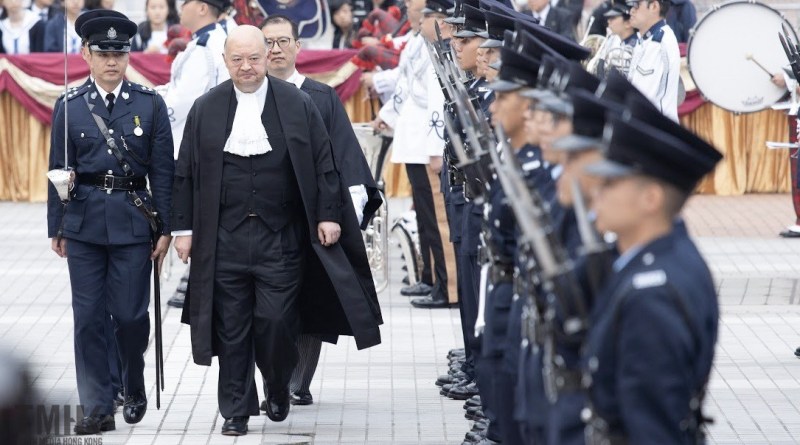
The meaning of “lynched” is well established. It means a mob hangs someone (see pic). Usually it is reserved for occasions when the mob is white and the victim is black. It is a universal characteristic of lynchings that at the end of them the victim is dead.


 tim's experiment
It is fortunate that gross oratorical overkill is not a criminal offence, because it seems to have become a habit among our local policemen. The prize for the finest specimen must go to the Police Inspectors’ Association for their response to the first protest around the police HQ, which included this gem:
“This sword of extreme humiliation has already stabbed to the heart of every colleague, and each of us are grieved and heartbroken.” The association conceded that nobody had actually been injured. Inspectors, it seems, have sensitive feelings.
I would like to make it clear at this point that I have no personal quarrel with our police force, which in its dealings with me has always been polite, friendly, legal and even hospitable. On the one occasion when I thought I might need their help they were touchingly eager to provide it.
Any consideration of police matters in Hong Kong has to start from the point that our police people are wonderful, most of the time.
On the other hand (I have written this before) I have some doubts about the force’s insistence that it is a paramilitary organisation, and the resulting approach to public order problems.
It is not true that, as Mr Li Fei said the other day, protests in Hong Kong always descend into violence. Quite the contrary. Whatever you think about the claims for their size Hong Kong people manage to hold very large protests which are extremely orderly, even to the extent of clearing up the resulting litter afterwards.
On the other hand the events of June 12 were not the first time that a good deal of violence has occurred, and so much of it came from the police that the force was ordered to lay off the streets for a while. So you have to wonder: is the Star Wars gear a good look?
The desirability of a police force which sees itself in paramilitary terms is an on-going controversy. Some European countries have a separate paramilitary force, like the CRS in France or the Carabinieri in Italy. Others have special units in an otherwise ostentatiously civilian force, like the UK and Ireland.
The US has multiple police forces and policies vary. On the whole the paramilitary model is in bad odour there, not so much because of public order problems as because of the use of SWAT-type teams to conduct what they call “no-knock entries”: swift drug raids in the hope that a sufficiently brusque approach will prevent miscreants from flushing the evidence. In a country awash with guns this often produces dangerous situations.
Let us, though, start with a view of the paramilitary approach to public order problems from an American policeman, Mr Norman Stamper. His thoughts on the subject start with an arresting intro (sorry): “As Seattle police chief in 1999, my disastrous response to the WTO protests should have been a cautionary tale. Yet our police forces have only become more militarized…”
“The paramilitary bureaucracy and the culture it engenders—a black-and-white world in which police unions serve above all to protect the brotherhood—is worse today than it was in the 1990s. Such agencies inevitably view protesters as the enemy. And young people, poor people and people of colour will forever experience the institution as an abusive, militaristic force—not just during demonstrations but every day…”
This is in an admirably brief version of the case against paramilitary policing: that it turns the police force into a separate tribe whose primary loyalty is to itself, that it results in an inappropriate approach to civilian protestors, and that this will eventually infect policing in general because of its effect on the way police perceive themselves and are perceived by other people.
Similar criticisms at book length can be found in a book by Tony Jefferson called “The case against paramilitary policing”. I cannot recommend this. It has compelling practical examples from the UK and Australia, but also a lot of post-modern Cultural Studies BS about hegemonic ideologies and such like.
Not all academics working in the area agree with Mr Jefferson. But plenty of them have come to similar conclusions.
Gillham and Marx, who studied the disorders in Ferguson, in the US, concluded that “Although increasing militarization provides protective equipment for police and superior force to potentially deter violent assaults against police or others, it can also reinforce feelings of fear and anger and the view that police are an occupying army rather than a public force that protects and serves its community. First Amendment [media] activities may be chilled, already damaged relations may be worsened, and police further delegitimized.”
Perry and others surveyed protestors who had participated in the “Occupy” movement in Israel in 2012, and found that “the perceived use of paramilitary methods has an independent and negative effect on trust, stronger than that of police effectiveness and the “neutrality” component of procedural justice. In‐depth interviews suggest that the significance of paramilitarism may be the … alienation and criminalization it elicits among protesters who generally perceive themselves as law‐abiding citizens.”
McCulloch studied policing in the State of Victoria, in Australia: “The research demonstrates that the Special Operations Group has been the harbinger of more military styles of policing involving high levels of confrontation, more lethal weapons and a greater range of weapons and more frequent recourse to deadly force….
“…the way public demonstrations and industrial disputes are viewed in police and security circles ensures that … counter terrorist tactics will be used to stifle dissent and protest. The move towards paramilitary policing is necessarily a move away from the police mandate to protect life, keep the peace and use only minimum force.”
Or here we have Cian Murphy on the situation in England and Ireland: “The effect of a squad system and quasi-military activity on police culture cannot be ignored. Police culture already suffers from machismo. Specialist paramilitary police sub-culture exacerbates this… The military model fosters the ‘we-them’ attitude, acts as a barrier to community relations, and promotes a warlike attitude.
“The effect is that these groups, generally deployed in hostile situations, view themselves as imposing peace, rather than fostering it. As one Brixtonian noted: ‘There’s a lot of boys, all psyched up…they want action’…
“Riot, it would seem, is prompted time and time again by police action… Police are ill equipped to act like soldiers: they do not have the luxury of seeing rioters as enemies; their role is to diffuse violence situations, not to engage in them. ‘Tooling-up’ dehumanises the police, making it easier for protestors to reconcile themselves with acting violently towards officers of the law.
“The sub-culture Jefferson observed in Special Patrol Groups was not unlike that of a military platoon patrolling a colony.”
Does that not sound a tiny bit familiar?
This brings us to the currently interesting question whether there should be some sort of inquiry into the events of June 12. Clearly the intention of some people calling for this is that such an inquiry would identify and condemn incidents in which the police had used force inappropriately or illegally.
This is no doubt also the reason some people are against it. We need not take very seriously the objection that there was violence from protestors as well. The individual protestor is not a government department. His responsibility for his actions is personal and legal. The police force is an organ of the government; the powers and actions of those who are authorised to carry and use lethal weapons on our behalf are a legitimate subject for public curiosity.
The idea that such an inquiry would be prejudiced against the police is also far-fetched. Work of this kind is usually entrusted to a senior judge. If there is any bias it will not be in that direction.
The point that some people seem to have trouble with is that there is not much point in going in great detail into what happened. I have no doubt that any inquiry which does this will conclude that everyone concerned on the side of order was either following the orders of a superior or exercising his discretion with the best intentions in the light of the equipment and training supplied and the doctrines established in the force.
On the other hand it can hardly be disputed that the outcome of the whole affair was less than ideal, particularly from the point of view of those injured or arrested. The number of people who were both injured and arrested is a bit disturbing. I cannot help recalling the case of the English PC who, on being told that the person he had arrested was not a rioter, replied over the radio (forgetting, no doubt, that such conversations are routinely recorded) “Well he’s going to have to be guilty of something because I’ve broken one of his teeth.”
The question which first arose during the tear gas festival which kicked off Occupy, and has now become more urgent, is whether the paramilitary model as presently followed is appropriate and necessary for Hong Kong.
Our police force has an unusual arrangement in that virtually all police people do the same special course at some point in their first three years in the force, and many of them do it again later. The course is an explicitly militaristic affair and would be an admirable preparation for the sort of riots which Hong Kong used to have in the 60s.
But having everyone do it means the military spirit pervades the force. Teamwork is a fine thing, but tribalism can be taken to excesses. It is noticeable that in none of the rare cases in which a police person is accused of using excessive or inappropriate force do we see a police person as a prosecution witness. Loyalty to colleagues trumps loyalty to the law.
Or indeed to anything else. The loyal toast “to the Queen” which used to be a part of formal regimental dinners had to be replaced after the handover. It was not replaced by a toast to the PRC or the SAR or their respective heads. The toast is now to “the Hong Kong Police Force”.
In defence of the current arrangements it is argued that the police have to have their own anti-riot (or Internal Security, as the euphemism has it) arrangements because unlike their counterparts in larger political units they have no neighbours they can call on for reinforcements.
Unstated, but no doubt not unthought, is also the point that unlike their colonial predecessors they cannot call on the support of British troops. Nobody wants to see what the PLA’s version of crowd control would look like.
Still, I think the point that needs to be examined is whether the undoubted need can be met without wholesale recourse to a police model which is generally assessed as lying somewhere between perilous and toxic. Being paramilitary seems to be an article of faith. Consequently no thought is given to the possibility of avoiding its less desirable features, still less to the attractions of changing to a civilian model and keeping pepper spray as a last resort.
I suppose there is some discussion of these matters behind the scenes. It is noticeable that after the shock and awe approach has failed we see experiments with more soothing methods like negotiation and deploying lots of lady cops.
This debate should take place in public. Policing is too important to be left to police people.
It is also too important to be left to the officials nominally in charge. Their reactions to June 12 did not inspire confidence. The Secretary for Security’s answer to questions about police people not displaying numbers on their uniforms was that the Star Wars kit did not have room for a numberplate. This was both irrelevant and untrue.
Meanwhile the chairman of the supposedly independent body which reviews the way complaints against the police are handled (the actual handling is done by the police themselves) said that they had not deployed observers for any of the recent protest marches or demonstrations because they were so big it would be impossible to see everything.
This is like the director of the Observatory deciding not to do typhoon warnings because typhoons are big and unpredictable. Not seeing everything is surely preferable to not seeing anything. Unless, of course, you do not wish to see anything…