Feeds:
Posts
Comments

Posts Tagged ‘dogs’

I owe regular readers a word of explanation for the recent silence in this space. I was bitten by a dog.

This is not, in the great scheme of things, a big deal. People are being starved in Gaza, massacred in Sudan, arrested in Hong Kong. My problem was minor. But it wasn’t minor for me.

In the first place, for a while I could not type. In fact I had for a week a taste of what my father (his right side paralysed by a stroke) had to put up with for two decades. The hand I usually do things with was not available (I am left-handed) and the other one turned out to be incompetent. Even eating was an embarrassment.

The actual experience of being bitten – small teeth sinking into my hand – was not that traumatic. As a promiscuous petter of other people’s dogs I have always known that something like this was possible. The person walking the dog, who was not the owner and had not been warned about his charge’s homicidal propensities, was more upset than I was.

The treatment is another matter. My local GP sent me to the Chinese U hospital, which for some obscure reason they prefer to call the Chinese University Medical Centre. It has an Emergency Medicine Department. Is there something behind this preference for different labels? Do they not want accidents?

Anyway the standard treatment for dog bites these days involves keeping the wound open for a week or two until any chance of infection can be excluded. I do not dispute the medical justification for this, and indeed it has worked as intended. But if you judge the efficacy of a medical procedure by the amount of pain involved then this one really gives you your money’s worth.

Every day I was wheeled into the ominously numbered Room 13, where a nurse (you only get a doctor for the needlework) would squirt disinfectant into my holes, wipe them with the surgical version of those sticks with a cotton bud on the end which people stick in their ears, and stuff them with lint, which would be pulled out at the beginning of the next day’s session and examined for evidence of corruption.

The nurses were all skillful professionals who were kind, careful and as gentle as the circumstances permitted. They were all women young enough to be my grand-daughters. So etiquette, at least for males of my vintage, demanded that a stoical indifference to pain should be deployed, or at least simulated.

Post-operative recovery was aided by a fun fact about the CUMC: it has a super coffee bar. If you’re down that way it’s “worth a detour”, as the Michelin people used to say.

Long-term consequences? My left hand is now fully functional, though it still has some interesting scars. I have noticed that at some sub-conscious level I no longer feel so confident around dogs. Some furry friend I have been fondling for months will come bouncing up and my hand twitches a bit, and avoids his mouth. This may pass, I hope.

It would be unfair to blame a whole breed for the actions of one individual but I am avoiding him and his relatives anyway. I am confirmed in my suspicion that pedigree dogs, like thoroughbred racehorses and Hapsburg emperors, are often inbred and consequently may land on the mental health scale somewhere between “highly strung” and “barking mad”.

Adopt an interesting local mixture from one of Hong Kong’s many dog rescue organisations and you will not get an entry in the canine Almanach de Gotha, but you will also not finish up with a psychopooch.

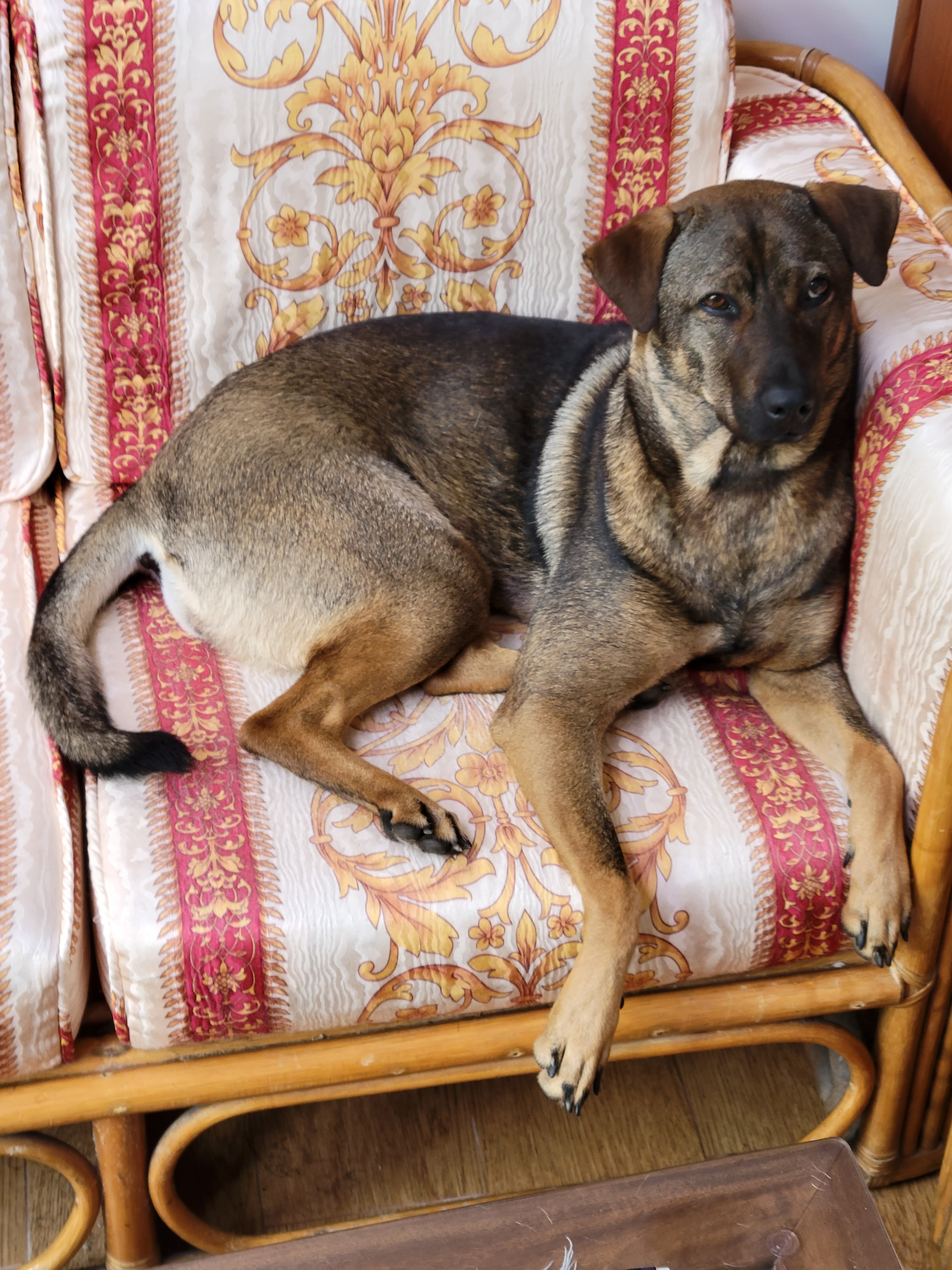
Happily I am still on cuddling terms with the lovely Lemon:
Read Full Post »

One of the strange things about the much-cited rule of law in Hong Kong is the way it swiftly dissipates as you move north from the Lion Rock Tunnel.

The New Territories is famous for its exceptions. The Small House Policy (under which male villagers can build a house, supposedly for their own use) is a racket. It has been a notorious racket for 50 years and has the additional drawback of being grossly discriminatory against women. It continues.

The construction of illegal additions to small houses is another flourishing area. Occasionally terrible threats are issued but somehow nothing comes of them and most rural villages, viewed from the air, offer a rich variety of unauthorised fourth floors.

Most people in Hong Kong are not allowed to celebrate the New Year with their own fireworks. Villagers are not covered by this. When I lived in a rural village I recall sitting on my balcony looking down the valley and seeing occasional bursts of firecrackers, followed by plumes of smoke drifting across the landscape. It was like living in Beirut.

I also noticed a suspiciously transient dog population. Eating dogs is not allowed in Hong Kong. Where were all these large black dogs going? I got on very well with my neighbours, by contributing to the village welfare fund and not asking tactless questions.

Anyway with this background in mind I was not horrified or disgusted by the latest legal triumph, the use of applications to use agricultural land for boarding kennels, as a way to cover it in concrete, with a later switch to something more lucrative and industrial.

This was discovered by a careful piece of freelance research by Liber Research Community. HKFP report here.

Reporting on issues of this kind is a delicate matter. One wishes to show readers an actual specimen of the abuse in progress. But this is fraught with danger. One may well suspect that Farmer Wong was not being frank when he applied to build a refuge for homeless dogs on one of his fields. Proving that his application was bogus is another matter even if, two years later, the field is covered with the remains of dead cars. Maybe the homeless hounds were not as numerous as Mr Wong thought.

On the other hand, looking at the overall figures it is depressingly clear what is going on. The researchers looked at 60 sites which had been approved for boarding kennels, of which 19 appeared to be accommodating dogs, 31 were not and ten remain a mystery.

They had no difficulty in finding sites which had completed the process from approval for animal boarding use to approved industrial use. What boggles the mind is the apparent failure of the officials involved to see what was going on.

Consider: between 2015 and 2017 the annual total of applications for planning permission to run animal boarding establishments was seven. Between 2018 and 2020 it averaged 16. The average for 2021-3 was 35. That means that in the last three years more than 100 applications have been filed to run animal boarding places in the New Territories.

Spokespeople for the Town Planning Board say that there is nothing wrong with people moving on from animal boarding to other uses provided they have the proper permission, and offered to inspect relevant sites.

But you have to ask yourself what these people were thinking. Is the market for dog hotels booming on a scale to justify doubling capacity every three years? Or have rural residents acquired a sudden sensitivity to the needs of strays?

The SPCA estimates that Hong Kong has a dog population of some 200,000, which clearly entails some exciting business opportunities. But a study of owner spending on pets found no detectable figure for boarding or hotel costs. Clearly most owners manage to cover holidays by leaving their pets with friends, family members or the domestic helper.

Moreover many boarding kennels operate quite happily in ordinary industrial or commercial buildings in the urban area. Only the owners of large dogs (like mine) need to worry about whether their canine friend will have access to open space.

I do not suggest that the New Territories are a criminals’ paradise. Nor do I wish to encourage paranoia. But a sudden surge in the popularity of a rather exotic land use application should surely have raised a red flag? Would it perhaps help if the protection of the rural environment attracted a small fraction of the law enforcement zeal devoted to the activities of subversive buskers, or the wearers of political tee-shirts.

Read Full Post »