It is a common experience among dog owners: you are walking your pet, you come across a complete stranger and he greets your pooch by name. This is particularly likely to happen of somebody else sometimes walks your dog, but it still happens if you do your own walks.
There is no mystery here. You talk to, or occasionally shout at, your dog by name. She does not reply with your name. Indeed I know quite a lot of the other dogs we often meet in the park by name. Their owners remain anonymous, though familiar.
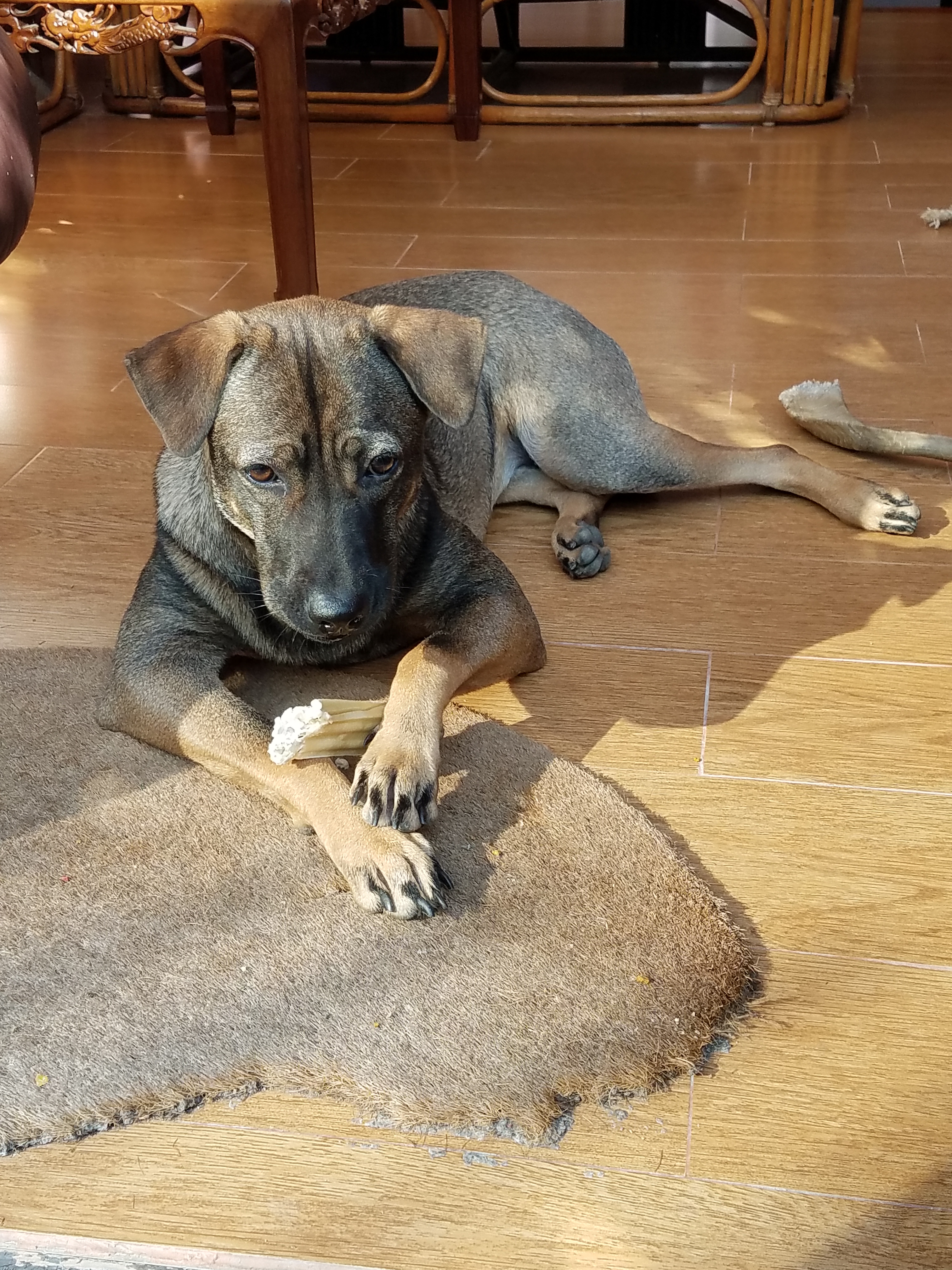
Still, there are limits. The other day I decided to take the minibus down from our hilltop to Fotan. I am usually motorised but Fotan has no convenient parking arrangements. I get off the bus in the wake of another passenger and she turns and asks “Are you Lemon?” Of course that is not what she meant. What she meant was that I was the person who walks Lemon. Note, though, that Lemon (who is my dog) was not present.
Anyway I had a pleasant chat with the lady who did not really think I was Lemon, and did some shopping.
An hour or so later I was waiting at the minibus stop for the trip home and a gentleman joined the queue behind me. “How is Lemon?” he asked. And we had another pleasant chat about our respective dogs.
So it seems my main claim to fame, at least round our part of the New Territories, is that I am Lemon’s walker. This is mildly disturbing.
In the days when I was on RTHK quite often I did have occasional encounters with people who might broadly be described as fans. I was, and indeed am still, a bit nervous when people come up to me and ask “Are you Tim Hamlett?” but they have always been polite and usually been flattering.
One of the drawbacks of appearing on television is that some people have difficulty getting their heads round the fact that they can see you but you can not look into the camera and see them. So they assume a degree of familiarity which grates a bit with my old-fashioned English ideas about how you interact with strangers.
Curiously, Lemon seems to have picked up her social habits from me. She does not interact with strangers. A quietly extended hand may be sniffed. If you try to pet her she shies away. If you ignore her completely she may take the initiative and sniff your feet. And that is it.
In fact the only time I have known her allow a stranger to touch her head at all was when we first met and she put her head in my hands. That is how I finished up with a large dog when I was looking for a small one. Lemon chose me.
And she has in many ways been the one in charge of the relationship ever since. Which is OK, I suppose. Just don’t tell her.
“Some we love, some we hate, some we eat,” was the title of a best-selling exploration of the relations between humans and animals, with the second title “Why it’s so hard to think straight about animals”.
The spectrum actually goes much wider than love, hatred and food, including animals as tourist attractions, animals as a mechanism for gambling, animals as laboratory subjects, and (still) animals as workers. And so on.
There is also the matter of more than one relationship coexisting. There was a touching moment in one edition of Clarkson’s farm, in which Mr C is accepting delivery of a consignment of sausages which were formerly some of his pigs. He muses on the paradox of livestock farming, that you love the animals and then send them to be killed. “Well’” says the sausage delivery man happily, “now you can love them in a different way.”
There seems to be a rather similar ambiguity in the Hong Kong government’s relationship with dogs. The traditional attitude was of unmistakable disapproval; licenses were issued but this was mainly a way to encourage vaccination against rabies. Public parks and public housing both excluded dogs.
Earlier in the year this seemed to have mellowed. Restaurants which wished to do so could apply for a permit to admit dogs. This coincided with the rise of the dog stroller, a sort of pram in which your pooch could visit a mall without his paws touching the floor. I now occasionally encounter small dogs in supermarkets.
In the last couple of weeks the relationship has become tricky again. Two dogs featured in horror stories: one fatally mauled two smaller dogs and the other killed the proprietor of the dog hotel it was staying at.
The official response was to reiterate the Ag and Fish Department’s safety doctrine, which is that dogs weighing more than 20 kg should be walked on a leash not more than 2 metres long. This seems to be based on the fallacious idea that large dogs are more belligerent than small ones (the dog which took a hunk out of me was one of those little Japanese jobs) and that short leashes give you more help than long ones (if your dog is a big puller the solution is to wear the leash round your waist).
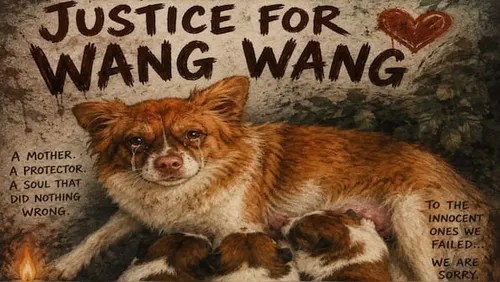
Meanwhile there was much anguish online over a China dog story. This involved a dog, usually referred to as Wang Wang, being killed in an unconscionably cruel way by a group of boys, who then beat her puppies to death.
This struck a chord in Hong Kong, leading several people to put pictures and tributes in public places. This in turn drew the attention of the national security paranoia people, who get the collywobbles over any wave of public sentiment not approved and initiated by the government. People who had put up pictures of the deceased dog were visited. Advice was offered. This would not be a good topic for a book.
Animal abuse is a crime in Hong Kong and cases are followed up, albeit with varying degrees of enthusiasm. Of the corresponding situation in China the less said the better.
Then we come to the matter of wild pigs. The situation for many years was that there were two pig-hunting teams, who would swing into action and shoot any pig which was making a nuisance of itself. Wild pigs are quite good at working out where they are not wanted so the pig-human relationship was reasonably stable.
It was then decided that having people shooting pigs for fun was a bit behind the times. The new arrangement was that erring pigs would be tranquillised and neutered. They could then be returned to the wild.
This was not a success. This should not have come as a big surprise. Youtube is infested with stories of wild pig problems from around the world. Wild pigs are resilient, intelligent and breed like rabbits.
In 2021 the policy changed again. Everyone who has written about this notes that the change came after a wild pig bit a policeman. This may have been a coincidence. Anyway the new policy was that wild pigs should be “euthanised” (the Legco euphemism) or “dispatched” (Ag and Fish) or, in words of one syllable, killed.
This is not wild life management. It is a hog holocaust. Since the new policy came in Hong Kong’s wild pig population has been cut by more than half.
From a global point of view the wild pig is in no danger. In many places they are regarded as a pest. In Canada they are enticed into huge traps because to make any headway against a wild pig population you need to catch a whole family together. In the US they use drones and snipers… of course. In Australia the pig population is kept in check by wild dogs and in Louisiana increasingly by cougars. In eastern and central Europe they are a traditional food item and are much hunted for the pot.
Most of these places probably envy Hong Kong, but I find the new policy difficult to admire. Of course we do not want wild pigs rooting through urban dustbins. On the other hand I infer from a recent experiment with three models of pig-proof bins that there was previously a problem with food being inadvertently offered in litterbins.
The winning bin model has now been installed round our way just as, it appears, the local pig population has been exterminated. We used to see wild pigs quite often. People did not try to feed or pet them and the pigs showed no interest in socialising with humans or dogs.
I had not seen a wild pig for weeks until the other night. The dog froze and stared at a bush. A pig then emerged from the bush and trotted away. It looked extremely fat. There are two possibilities. It might be the young boar we saw quite often last year, grown obese because so many competitors have been bumped off and it now has all the local rubbish collection points to itself
The other possibility is that I got its gender wrong and she’s pregnant. I will post updates.
I owe regular readers a word of explanation for the recent silence in this space. I was bitten by a dog.
This is not, in the great scheme of things, a big deal. People are being starved in Gaza, massacred in Sudan, arrested in Hong Kong. My problem was minor. But it wasn’t minor for me.
In the first place, for a while I could not type. In fact I had for a week a taste of what my father (his right side paralysed by a stroke) had to put up with for two decades. The hand I usually do things with was not available (I am left-handed) and the other one turned out to be incompetent. Even eating was an embarrassment.
The actual experience of being bitten – small teeth sinking into my hand – was not that traumatic. As a promiscuous petter of other people’s dogs I have always known that something like this was possible. The person walking the dog, who was not the owner and had not been warned about his charge’s homicidal propensities, was more upset than I was.
The treatment is another matter. My local GP sent me to the Chinese U hospital, which for some obscure reason they prefer to call the Chinese University Medical Centre. It has an Emergency Medicine Department. Is there something behind this preference for different labels? Do they not want accidents?
Anyway the standard treatment for dog bites these days involves keeping the wound open for a week or two until any chance of infection can be excluded. I do not dispute the medical justification for this, and indeed it has worked as intended. But if you judge the efficacy of a medical procedure by the amount of pain involved then this one really gives you your money’s worth.
Every day I was wheeled into the ominously numbered Room 13, where a nurse (you only get a doctor for the needlework) would squirt disinfectant into my holes, wipe them with the surgical version of those sticks with a cotton bud on the end which people stick in their ears, and stuff them with lint, which would be pulled out at the beginning of the next day’s session and examined for evidence of corruption.
The nurses were all skillful professionals who were kind, careful and as gentle as the circumstances permitted. They were all women young enough to be my grand-daughters. So etiquette, at least for males of my vintage, demanded that a stoical indifference to pain should be deployed, or at least simulated.
Post-operative recovery was aided by a fun fact about the CUMC: it has a super coffee bar. If you’re down that way it’s “worth a detour”, as the Michelin people used to say.
Long-term consequences? My left hand is now fully functional, though it still has some interesting scars. I have noticed that at some sub-conscious level I no longer feel so confident around dogs. Some furry friend I have been fondling for months will come bouncing up and my hand twitches a bit, and avoids his mouth. This may pass, I hope.
It would be unfair to blame a whole breed for the actions of one individual but I am avoiding him and his relatives anyway. I am confirmed in my suspicion that pedigree dogs, like thoroughbred racehorses and Hapsburg emperors, are often inbred and consequently may land on the mental health scale somewhere between “highly strung” and “barking mad”.
Adopt an interesting local mixture from one of Hong Kong’s many dog rescue organisations and you will not get an entry in the canine Almanach de Gotha, but you will also not finish up with a psychopooch.
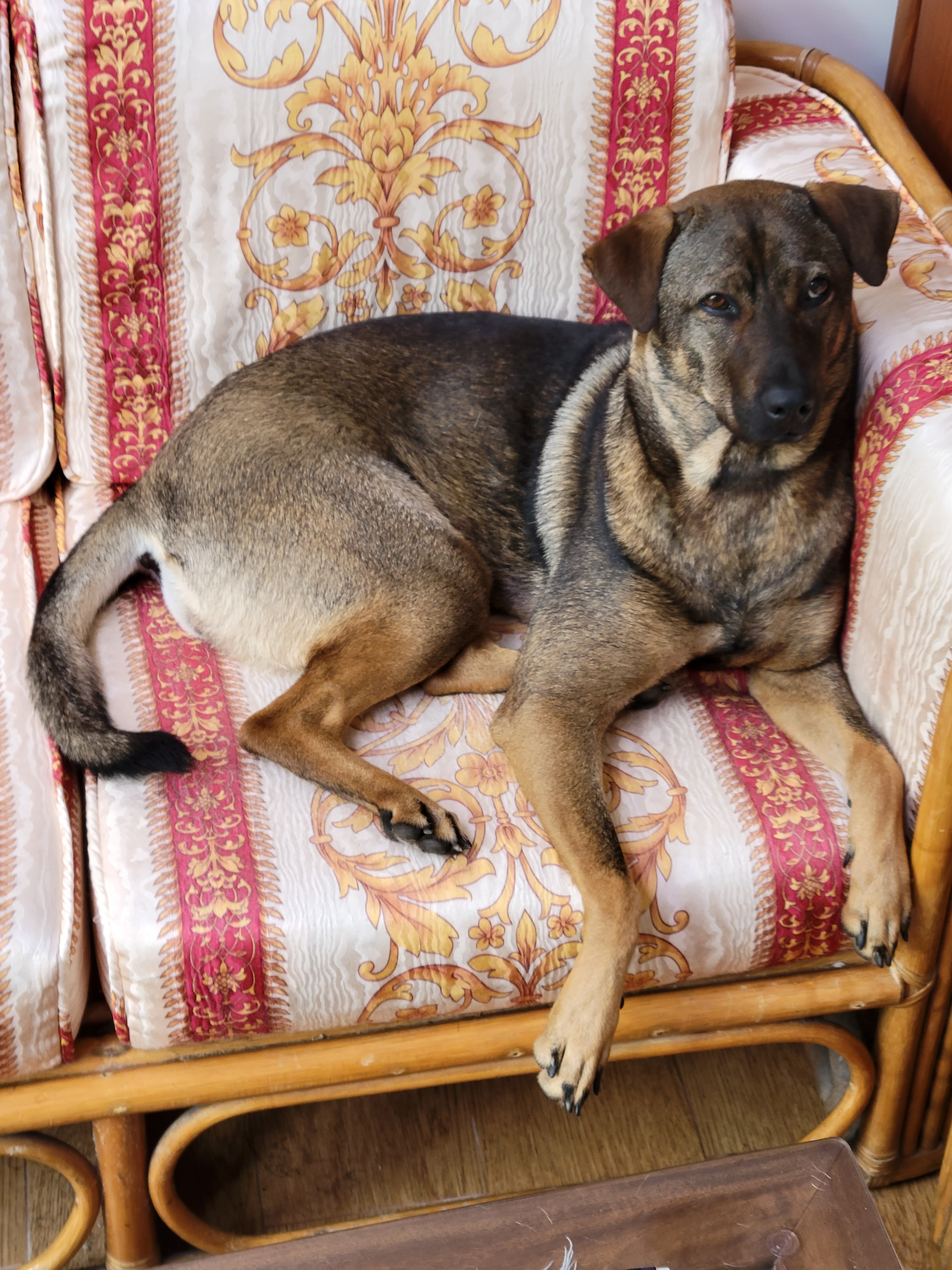
Happily I am still on cuddling terms with the lovely Lemon:
One of the strange things about the much-cited rule of law in Hong Kong is the way it swiftly dissipates as you move north from the Lion Rock Tunnel.
The New Territories is famous for its exceptions. The Small House Policy (under which male villagers can build a house, supposedly for their own use) is a racket. It has been a notorious racket for 50 years and has the additional drawback of being grossly discriminatory against women. It continues.
The construction of illegal additions to small houses is another flourishing area. Occasionally terrible threats are issued but somehow nothing comes of them and most rural villages, viewed from the air, offer a rich variety of unauthorised fourth floors.
Most people in Hong Kong are not allowed to celebrate the New Year with their own fireworks. Villagers are not covered by this. When I lived in a rural village I recall sitting on my balcony looking down the valley and seeing occasional bursts of firecrackers, followed by plumes of smoke drifting across the landscape. It was like living in Beirut.
I also noticed a suspiciously transient dog population. Eating dogs is not allowed in Hong Kong. Where were all these large black dogs going? I got on very well with my neighbours, by contributing to the village welfare fund and not asking tactless questions.
Anyway with this background in mind I was not horrified or disgusted by the latest legal triumph, the use of applications to use agricultural land for boarding kennels, as a way to cover it in concrete, with a later switch to something more lucrative and industrial.
This was discovered by a careful piece of freelance research by Liber Research Community. HKFP report here.
Reporting on issues of this kind is a delicate matter. One wishes to show readers an actual specimen of the abuse in progress. But this is fraught with danger. One may well suspect that Farmer Wong was not being frank when he applied to build a refuge for homeless dogs on one of his fields. Proving that his application was bogus is another matter even if, two years later, the field is covered with the remains of dead cars. Maybe the homeless hounds were not as numerous as Mr Wong thought.
On the other hand, looking at the overall figures it is depressingly clear what is going on. The researchers looked at 60 sites which had been approved for boarding kennels, of which 19 appeared to be accommodating dogs, 31 were not and ten remain a mystery.
They had no difficulty in finding sites which had completed the process from approval for animal boarding use to approved industrial use. What boggles the mind is the apparent failure of the officials involved to see what was going on.
Consider: between 2015 and 2017 the annual total of applications for planning permission to run animal boarding establishments was seven. Between 2018 and 2020 it averaged 16. The average for 2021-3 was 35. That means that in the last three years more than 100 applications have been filed to run animal boarding places in the New Territories.
Spokespeople for the Town Planning Board say that there is nothing wrong with people moving on from animal boarding to other uses provided they have the proper permission, and offered to inspect relevant sites.
But you have to ask yourself what these people were thinking. Is the market for dog hotels booming on a scale to justify doubling capacity every three years? Or have rural residents acquired a sudden sensitivity to the needs of strays?
The SPCA estimates that Hong Kong has a dog population of some 200,000, which clearly entails some exciting business opportunities. But a study of owner spending on pets found no detectable figure for boarding or hotel costs. Clearly most owners manage to cover holidays by leaving their pets with friends, family members or the domestic helper.
Moreover many boarding kennels operate quite happily in ordinary industrial or commercial buildings in the urban area. Only the owners of large dogs (like mine) need to worry about whether their canine friend will have access to open space.
I do not suggest that the New Territories are a criminals’ paradise. Nor do I wish to encourage paranoia. But a sudden surge in the popularity of a rather exotic land use application should surely have raised a red flag? Would it perhaps help if the protection of the rural environment attracted a small fraction of the law enforcement zeal devoted to the activities of subversive buskers, or the wearers of political tee-shirts.