Feeds:
Posts
Comments

Posts Tagged ‘Hong Kong’

What, I wonder, is a mega event? This question arises from a Legco answer provided by our newly minted Secretary for Culture, Sports and Tourism, Ms Rosanna Law.

Ms Law gave a glowing report on her branch’s efforts to boost tourism. You might even wonder, reading her update on the situation, what her predecessor did wrong.

According to Ms Law, as reported in the China Daily, there were 110 mega events in the first half of this year. I do not remember hearing or reading about 110 events worthy of the “mega” label, which according to the Cambridge Dictionary means “very good or very big”.

And the fact that these events are allegedly happening at a rate of about 18 a month, or roughly one every two days, suggests that the adjective has been devalued by overuse. This suspicion was not dispelled by the China Daily, which illustrated the happy news with a picture of the Hong Kong Sevens, and in the article mentioned only the Art Basel culture fest. Both these events have been staged annually for many years. They may be well be “mega”, but giving the credit to the current Culture, Sports and Tourism bureaucracy seems a bit of a stretch.

Ms Law said the mega events had attracted 550,000 tourists who spent $2.4 billion, and also contributed a “value add” of $1.4 billion, a mysterious extra benefit which she did not explain. These are big numbers, at least until you look at the official Tourism Board visitor figures for the same period, which run to about 3.5 million per month.

Well the show goes on. Ms Law said $100 million had been earmarked for the Mega Events Coordination Group’s work over the next three years. It is difficult to know what is happening here. We do not know which of these events are a result of official inspiration, and which are items which were going on anyway, but were happy to sport the “mega event” label in return for a chance to bid for some cash and get free publicity when the Tourism Board, in Ms Law’s mellifluous phrase, “leveraged its global network to carry out publicity in the Chinese mainland and overseas.”

Doubts arise. As a product of the post-war baby boom I witnessed years of arguments in the UK about which activities should be undertaken by government and which by the private sector. But even avid seekers of public control of the “commanding heights of the economy” recognised that arts and culture were best left to voluntary and commercial effort. If subsidies were provided this should be done in a way insulated from official control, like the money given to universities.

The reason for this is the general experience that officially devised entertainments will be either uninspiring, loss-making or both.

There is, to put it politely, no evidence that Hong Kong is exceptional in this matter. Money effortlessly disappears in the Magic Kingdom, Ocean Park and Water World. The West Kowloon Cultural District is looking for a life boat, probably involving the fine art of selling expensive flats.

I seem to have caused some confusion last week by mentioning the Capital Works Fund in the same column as the third runway, which was not financed that way. Besides milking passing passengers the airport took on $110 trillion of debt – which whatever the fine print says is effectively backed by the Hong Kong government.

My point was that having a huge pile of money which could only be spent on building encouraged a mindset in which any pyramid, sphinx or ziggurat could be erected free from financial concerns because the supply of money was apparently unlimited. This led to extravagant choices, of which the third runway was one.

The idea that events should be supported by an all-purpose body selecting items on the basis of their prospects as tourist attractions is another. How are meaningful comparisons to be made between – say – a golf tournament, a performance of Aida and a chance to be bored in a conference centre by the CEOs of several international companies?

Money will be spent, certainly, but much of it will be wasted on events which would have happened anyway, or events to which the “mega” label is a polite joke. What is to be done?

In the long run we need perhaps to consider that erecting a pyramid without considering the running costs is a recipe for unhappiness. Museums and theatres are not supposed to make money. They are supposed to be provided as a service to the public and this implies a willingness to provide continuing support.

We also need to consider that what is happening today is not always a reliable guide to what will happen tomorrow. Shit, as they say, happens. Since the handover Hong Kong has had to deal with an Asian financial crisis, two political upheavals, and two epidemics. Technologies and tastes have changed rapidly. The rosy scenario is not always the one we get.

More immediately, as the government is wallowing in a financial crisis, perhaps they could start by cancelling the Mega Events Coordination Group and saving $100 million. The government’s role in fostering mega events should be confined to ensuring there are suitable venues for them. Left to themselves, the relevant industries will produce a steady flow of conferences, festivals, shows, opportunities to buy expensive items or to watch Lionel Messi watch a football match. The SAR government can stay out of show business.
Read Full Post »

The third runway system, the latest expensive adornment to Hong Kong’s international airport, came into full-time operation this month. This should be distinguished from the third runway itself, which opened in 2022.

During the ensuing two years one of the older runways was closed for “maintenance”, which might arouse suspicions that the extra runway was perhaps not urgently needed.

Nevertheless the opening of the new system was greeted with unrestrained joy. “The three-runway system has been hailed as a ‘game-changer’ for the city to enhance its status as an international aviation hub,” reported the Post from the official opening.

A China Daily writer described the new system as “more than a runway; it’s a bridge to new economic vistas that will invigorate the city’s future.”

Certainly it’s more than a runway. It could be regarded as a suitable commemoration for the Capital Works Fund, a curious financial arrangement inherited from the colonial era.

The basic idea was that income from land sales could not be depended on, and should accordingly not be relied on to cover the government’s running costs. Instead it should be put in a special pot, to be drawn on only for infrastructure projects which would be one-off bursts of expenditure.

This bit of fiscal puritanism may be compared with the present arrangement under which the proceeds of the sale of bonds (which will have to be repaid some day) are treated as income. But let us leave the financial technicalities aside. Basically we were presented with a government looking at a large pile of money which could only be spent on infrastructure projects.

Call me a cynic if you will, but I would expect that to produce a growing enthusiasm for expensive and elaborate projects, with an increasing likelihood of white elephant production. Bridges, railway lines, reclamation of whole islands … Is this starting to look familiar?

All of these projects will be defended as contributing to Hong Kong’s future prosperity and status as some kind of hub. Let me dispose of two points before we get to the airport itself.

Firstly, as Kuper and Symanski point out, economists firmly believe that people respond to incentives, and economists certainly do. No plan for a sports facility or festival ever comes without a glowing prediction from an economist of the future wealth it will generate for the hapless taxpayers who are invited to pay for it. So it goes also for infrastructure projects.

The third runway can probably claim some sort of record in this area, as it was justified by a prediction of $455 billion in economic benefits … spread over the next 50 years. You can see that far ahead? J.K. Galbraith said, “The only function of economic forecasting is to make astrology look respectable.”

Secondly let us be wary of a promised “boost for tourism”. If you are a tourist-attractive island which can only be reached by the use of a small and uncomfortable ferry (as the Isle of Sky once was) then building a bridge will attract a lot of the formerly discouraged and will boost tourism (as it did).

If you are a coastal European city with the usual kit – city walls, cathedral, town hall, famous man’s birthplace – and cruise lines are by-passing your pathetic port, then constructing a cruise terminal may bring a new flood of people who used to miss you.

On the other hand if you are getting a million tourists a year, and your airport can handle two million, then upgrading it to a capacity of three million is not going to make the slightest difference. People are not going to visit specially to see the new airport. It is a means to an end.

And this brings us to the impact, or lack of impact, of the new runway. In 2015 an assessment of the situation was produced for planners and legislators. Keeping the airport as it was (Option A) implied a maximum annual capacity of 57 million passengers and 4.4 million tonnes of cargo. Making improvements but not extending them to a third runway (B) could raise this to 77 million passengers and 6.1 million tonnes. Option C – the third runway – would increase capacity to 102 million passengers and 8.9 million tonnes.

How much capacity did we actually use in 2023, the last full year? Ah, 43 million passengers and 4.2 million tonnes. In other words, comfortably within Option A.

The Airport Authority asserts that usage was depressed during COVID and will eventually recover. But is this inevitable, or even likely? Views differ. Since 2015 rival international airports have expanded in Shenzhen and Zhuhai. Passengers on shorter routes from Chinese cities can also consider the express rail link, which opened in 2018.

Spokespeople for the authority say that the airport is already busy again in rush hours. But these are not like land-based rush hours, caused by lots of people going to and from work at the same time. They are caused by airlines, for reasons of their own, all wanting to land and take off at the same time.

Catering to this urge is wasteful. Another way of looking at airport capacity is the number of movements it can handle. Because aircraft, once up, have to be kept two minutes apart there is a fixed ceiling of about 30 movements an hour per runway. Clearly with three runways you can hope to handle 90 movements an hour, which is an improvement.

But here again we seem to be meeting a non-existent need. In 2018, the last year before various interruptions culminating in COVID, the airport handled 427,000 movements. In 2023 it handled 276,000. This year so far we have 298,000. Clearly the figure is still rising, but has a long way to go before it catches up with the number achieved with two runways alone.

Given that the government is now running a huge deficit and is no doubt contemplating something painful in the way of increased taxes and lower benefits, it is quite understandable that the “line to take” is not that they blew $140 billion to provide some extra convenience to airlines.

So roll up for the new epoch, which will either feature massive financial losses or mass tourism. Are we having fun yet?

Read Full Post »

Civil servants are to get a new set of guidelines next year, according to Security Secretary Chris Tang, which will show them how to safeguard national security in their daily duties.

Announcing this interesting project in Legco, Mr Tang said the exercise would “change the mentality and mindset of our colleagues, to embed the concept of national security in their brains.”

This seems to be asking a lot from a set of guidelines. But the really puzzling bit comes next. The new guidelines will be confidential. I quote from the HKFP report: “It must be confidential. If others know about how we remind our colleagues [to safeguard national security], those endangering national security will try to escape from [being caught],” Tang said in Cantonese.

And at this point Mr Tang really seems to have crossed from optimistic to delusional. According to the government publication Hong Kong the Facts, “As at March 31, 2024, the civil service employed about 173,100 people (excluding judges, judicial officers, officers of the Independent Commission Against Corruption and locally engaged staff working in the Hong Kong Economic and Trade Offices outside Hong Kong) or about 4.6 per cent of Hong Kong’s labour force.

Under modern circumstances – or for that matter in ancient ones – the idea of a secret being preserved between more than 170,.000 people is clearly preposterous. A professional spy will laugh at the idea. With so many targets he will expect to have an informant already – motivated in the usual way by ideology, money or sex – who will pass him the guidelines in a matter of days.

The amateurs who just enjoy sticking it to the Man will need a bit longer. But the end result will be the same. We could run a sweepstake on how long it will take before the guidelines are uploaded to some subversive website beyond the reach of the Hong Kong government. What is your money on? One month? Two?

The good news for Mr Tang is that this is unlikely to be a huge help to people who do not care for national security.

His idea seems to be that there is some secret giveaway, known to the Security Branch but not to its assorted enemies, which the well-briefed civil servant can spot in a subversive. If this secret gets out, then the assorted enemies can change their spots, abandon their tell-tales, whatever they are, and so avoid detection.

This sounds very much like the sort of thing which used to go on in European countries when they still believed in witches. Elderly lady living alone? Suspicious. She has a cat? Clearly an emissary from the Dark Lord. She has a broomstick? What more evidence to we need? Send for the witchfinder, who will find the definitive sign: a place where she does not feel pain.

We can all look forward with interest to discovering what the secret giveaway for national security violators might be. A foreign phone? Stays late in the office alone? Arrives early? Wears Pooh Bear tee-shirts at the weekends?

There is a serious side to this, of course. Whatever the concealed Mark of Treason might be, it is not going to be conducive to good morale if everyone in the civil service is constantly casting a suspicious eye over his colleagues.

There will, I fear, be cases in which a sincere mistake is made, leading to unjustified suspicion being cast, and much distress and anxiety to the victim. Alas, there will also probably be cases in which a spurious mistake is made, as a way of putting a spoke in the wheel of some rival candidate for promotion or apres-office sex. If you give everyone a dangerous weapon some people will mishandle it.

I do wonder if someone could perhaps persuade Mr Tang that even in national security matters there can be such a thing as Having Too Much of a Good Thing.

Civil servants are already required to swear allegiance to the government. Their code of conduct now starts with “upholding the constitutional order and national security.” Judicious pruning has removed objectivity and impartiality, so the persecution of independent bookshops and inconvenient political bodies is now unimpeded.

Most civil service jobs have little or no connection to national security, however broadly defined. They have taken the oath and read the code. Surely that should be enough. Or are they also required to love Big Brother?

Read Full Post »

Sniping at Carrie Lam is a tempting option for legislators and other politicos these days. It allows the critic to appear independent and outspoken without incurring the risks involved in complaining about the current regime.

It is a bit like flogging a dead horse but perhaps more like pulling the tail of a stuffed tiger; it looks good in your selfies without involving any real danger.

So it came about that there was much wailing and gnashing of teeth over the discovery that Ms Lam’s office, which comes her way on the public tab because one is provided for all former Chief Executives, was costing $9 million a year. Most of this goes on the rent for the office, which is in Pacific Place. Follow-up questions elicited the fact that this arrangement had cost $22 million in two years.

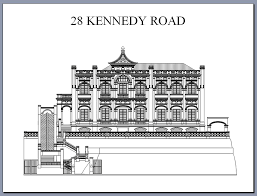
What, cries the well-informed connoisseur of Hong Kong historic architecture, why is Ms Lam not in the building at 28 Kennedy Road, lavishly redecorated and designated for the use of retired chiefs since 2005? Well it’s a long story.

This handsome building is of some age, and is listed as a Grade 1 landmark. It enjoyed a period of modest fame 30 years ago, when it was the Hong Kong home of the Sino-British Joint Liaison Group. The Group was set up under the Sino-British Declaration on Hong Kong’s future in 1985 to settle the finer points of the transition to come, and continued to meet until 1999, two years after the handover.

After this the building seems to have been left empty, as it presented a small problem. It is too big to be a company home, too small to house a government department, and cannot be extensively modified because of its Grade 1 listed status.

In 2005 came a brainwave. Mr Tung Chee-hwa, the first Chief Executive of the Hong Kong SAR, had resigned on grounds of ill health. The former Liaison Office’s home would make a nice office in the mid-levels for Mr Tung and his successor ex-Chief Executives.

As the Legco paper put it at the time, rather prematurely because there was only one Former CE at the time:

The Office provides administrative support to Former Chief Executives to perform promotional, protocol-related, or any other activities in relation to their former official role. The activities include receiving visiting dignitaries and delegations, giving local and overseas media interviews, and taking part in speaking engagements. The office shall provide administrative support for scheduling and making arrangements for public and social appointments, handling correspondence and enquiries, and dealing with general administrative duties.

The paper went on to estimate the annual cost of this arrangement at $2.2 million, most of which would go on the wages of three secretarial staff and a driver.

In 2008 the conversion of the building was completed, marked by the issuing of a triumphant video (link here) and a brief opportunity for members of the public to visit and admire the premises. The first floor has two lounges and a meeting room, and on the next floor up are three offices for ex-CEs. These are quite lavish. You could land an aeroplane on the desk supplied, and there is also a coffee table, armchairs and such. Space has not been skimped.

The provision of three offices seemed reasonable at the time. CEs, it was no doubt supposed, would be appointed at about the age of 60. This was a good guess: age on appointment of the crop so far 59, 60, 57, 60, 64. Average: 60.

Less happily, the planners seem to have assumed that CEs would generally serve the maximum two permitted terms. This would mean the former CE would be on average 70 when retiring. Turning to the relevant Census and Statistics tables we see that a 70-year-old man (CEs are usually men) can on average look forward to another 17 years of life. Under these circumstances – appointment at 60 and ten years in office – when a new CE takes over his predecessor will have 17 years ahead of him, his predecessor in turn will be seven years from the Pearly Gates, and his predecessor in turn will no longer be with us. Three offices will be quite sufficient. On average one will be empty.

Several things went wrong with this prediction. The first is that the expectation of life tables include people who reach 70 already sick and senile. CE candidates are, we hope, picked from the ranks of the fit and frisky. They are likely to be healthier than the aged population in general.

The second problem is the well-established scientific fact that people with prestige do seem to derive some medical advantage from it. Politicians who become ministers live longer, on average, than those who remain mere MPs. Senior civil servants live longer than junior ones, actors who win Oscars last longer than those who do not, and so on. Being at the top of the pecking order is good for your health.

So the provision of three offices may already have been a bit optimistic. What really sabotaged the scheme, though, was the failure of successive Chief Executives to serve a second term. Tung Che-hwa resigned two years and a few months after being elected to a second term. His successor, Donald Tsang, served the remainder of Mr Tung’s second term and was elected to a full term of his own. It was then ruled that he had had the maximum two goes already. The next two CEs both served just one term each.

The current CE, John Lee, will be 69 at the end of his first term, which may appear to him, or to the selectors, to be more than enough. We shall see. But the shortage of desk space for former CEs is probably not going to go away anyway. Leung Chun-ying was the youngest CE so far and Carrie Lam, being female, may well go on for ever.

But there is, at present, no room for Ms Lam in the historic building, leading to the leasing of a substitute in Pacific Place. This can hardly have been the cheapest option.

What is to be done? One legislator suggested that the provision of a free office and associated goodies should be confined to the most recent three CEs, others being presumably left to fend for themselves. This has something to be said for it: do we really want 80plus-year-old dinosaurs meeting visitors, giving media interviews, or making public speeches?

Well I don’t know. People last better than they used to. Speaking as someone who will shortly pass the same landmark I don’t think 80 is that old.

What do they do in other places? There is a problem here. The Chief Executive is not a head of state. In some jurisdictions he would be considered scarcely a Governor. Unsympathetic observers might describe the job as little more than a mayorship.

Diligent searching, however, reveals no examples of places which provide offices for ex-mayors, or even for ex-governors. Google users will be entertained by numerous updates from a Nigerian province where the governor indignantly denies reports that his predecessor has set up an office in the gubernatorial palace.

So, while acknowledging that we are not really comparing like with like here, the arrangement for UK ex-prime ministers is that they can claim up to £120,000 for “office costs and secretarial costs arising from their special position in public life.” As you will see from the table John Major (now 81) is still in business. No claims have been received from Boris (too disorganised?) or Rishi (too rich?) but Liz Truss, famous for her lettuce-length term of office, has already started collecting. So, up to about HK$1.1 million a year.

Much information is available about former US presidents, who are, at least to me, surprisingly numerous. According to the table here in the last 25 years the US has supported eight former presidents of whom five are still with us. This involved a total of 109 ex-president/years for a total of US$125 million, or US$1.1 million per president/year, which would be about HK$8 million in round figures. But this includes the president’s pension, travel and other expenses, which occupies about half of the total, so the figure for office and other amenities would be about HK$4 million.

So by international standards the originally projected figure of $2.2 million a year was generous, the expenditure of $11 million a year on Ms Lam was extravagant. But of course these sums are chicken feed by government spending standards; legislators should have more urgent things to looks at.

I do wonder, though, if former CEs really need a personal secretary and a clerical assistant each. In these digital days we can all type. Are these two people really busy, or are they like the two women standing behind the emperor’s throne in a Chinese opera: not doing anything but an important badge of rank?

I also have some difficulty with the Administration Office’s report that in her two years as an ex-CE Ms Lam has “attended 700 functions”. With all due respect for Ms Lam’s Stakhanovite work ethic, that is almost a function a day. Many of us find that the mention of Ms Lam brings back unhappy memories, some of which were not her fault (COVID) and some of which were. But 350 functions a year? One can only feel terror and pity.

Read Full Post »

Lord Sumption, a retired British Judge and formerly one of our token foreigners on the Court of Final Appeal, was roundly denounced by the usual government spokesman when he marked his retirement from the CFA with an article in the Financial Times, complaining that the rule of law could no longer be relied on in Hong Kong.

“The rule of law is profoundly compromised in any area about which the government feels strongly,” his Lordship wrote. And this brings us to recent developments in the case of Mr Kinson Cheung King-sang. Before we get to the developments, though, some background.

Mr Cheung was the chairman of the Hong Kong University Students’ Union, back in the days when students were allowed such things. The union’s committee, in an ill-advised moment, passed a motion expressing sympathy for a man who had attacked a policeman and then killed himself.

The motion was rescinded the following day, but this was not enough to head off a major reaction in pro-government circles and several students, including Mr Cheung, were arrested. Three people were eventually charged: the proposer and seconder of the errant motion, and Mr Cheung because he chaired the meeting. When I was a student union chairman I was expected to be neutral when chairing meetings, so this looks a bit odd. But they’re not hot on democratic conventions in pro-government circles.

The three chosen ones were charged initially with encouraging terrorism, an offence under the Beijing-imposed National Security Law. After negotiations this charge was replaced with “incitement to wounding with intent”, an obscure but ancient and respectable limb of the Common Law. The three defendants then pleaded guilty. This enshrined an interesting legal notion, that the union’s motion had “incited” an act which had already happened when it was passed, and whose perpetrator was dead. Well, lawyers understand these things.

We must note at this point that Hong Kong now has in effect two legal systems. One of them, which we may call option A, is the traditional one, based roughly on the notion that, as the legendary jurist Blackstone put it, “it is better that ten guilty men go free than one innocent one suffer.”

The other one, option B, is for national security cases only, and dispenses with precautions – some of which go back to Blackstone’s time (1723-1780) – intended to reduce innocent suffering. Getting our ten guilty men behind bars gets a higher priority.

So the defendant no longer has the right to be brought promptly before a magistrate, the right to bail, the right to a jury in serious cases, the right to a judge not selected by the prosecution, or the right to the counsel of his choice. Reading national security cases one sometimes wonders if the presumption of innocence has been eroded a bit as well.

Another feature of option B is a limitation on the right of a convicted prisoner to participate in early release arrangements for prisoners who behave themselves in jail. This was not part of the gift from Beijing; it was a local inspiration incorporated in the Safeguarding National Security Ordinance. Inmates may be released early only if the Commissioner for Correctional Services is satisfied that such release will not endanger national security.

So here we have Mr Cheung, so far subject to option A, under which he was sentenced to two years in prison. He then appealed on the grounds that the sentence was too severe. The Court of Appeal agreed, replacing his two-year sentence with one of 15 months. The interesting consequence of this was that, assuming the usual discount for good behaviour, he was now eligible for release. The law works slowly these days.

But nothing happened. Mr Cheung was not released. He then applied to a High Court judge to order his release. At the first hearing the judge was sufficiently impressed to consider releasing him on bail pending full discussion of the matter, but was talked out of it by counsel for the government.

The following day a magical transition had occurred: Mr Cheung’s legal ordeal had been moved from option A to option B. The Commissioner for Correctional Services, apparently a fast worker, had accordingly considered whether Mr Cheung’s release would endanger national security, and decided it would.

The magical transition took the form of a decision of the National Security Committee, a gathering of government security bigwigs including an “adviser” who represents our landlord. The NSC had ruled that Cheung’s offence “involved national security” and that his early release would be “contrary to the interests of national security.”

Senior Counsel Mike Lui, representing the government, said “The development since the adjournment yesterday has been nothing short of momentous,” with which one can only agree.

The National Security Committee was set up under the National Security Law, which outlines its powers and duties as follows:

The duties of the National Security Committee are to analyze and assess developments in relation to the safeguarding of national security in the HKSAR, make work plans, formulate policies, advance the development of the legal system and enforcement mechanisms, and coordinate major work and significant operations.

Call me a legal pedant, but I do not see anything there which suggests that the National Security Committee has a role in adjudicating on individual cases, or that it would be proper for the NSC to issue detailed instructions to a judge hearing a case. The local Nat Sec law, on the other hand, says that:

The courts are to adjudicate cases concerning national security independently in accordance with the relevant provisions of the Basic Law and the HK National Security law, free from any interference.

I infer that the judge in this case had the cart the wrong end of the horse when she said that “No jurisdiction [in Hong Kong], including the Judiciary, shall interfere with the decision made by the [national security committee]. His detention is fully lawful.” Did it not occur to the learned judge at all that the NSC might be exceeding its powers, or are we now so cowed that the idea of a government body exceeding its powers has become meaningless?

In jurisdictions which enjoy the rule of law it is out of order for essentially political or administrative bodies to jog the elbow of judges actually adjudicating cases. The committee, or the legislature, may change the rules, but in the meantime defendants and convicts are entitled to know what rules apply to them. This case is a grotesque parody of the rule of law, the more unpalatable because the government seems to be motivated entirely by the spiteful inclination to nullify the Court of Appeal’s decision and keep Mr Cheung behind bars for as long as possible.

After all the implications for national security are trivial: Mr Cheung will be free in November anyway. I also note that the judge who granted Mr Cheung pre-trial bail (over-ruling a magistrate who had refused it) did not seem to think that Mr Cheung was a great threat to national security.

I met a lot of student union chairmen when I was one. Two of the creepier specimens eventually became government ministers. Nobody became a revolutionary. I am sure Mr Cheung will in due course become a respectable member of society … with, perhaps, some highly critical views of the Hong Kong legal system.

Read Full Post »

Malcom Gladwell is a great populariser of scientific obscurities, so we now all know that in order to achieve proficiency in almost any worthwhile pursuit you have to put in 10,000 hours of practice. Or alternatively, it now appears, you can outsource the grunt work to a computer and just claim the credit.

This has led to much discussion in the places on the internet where writers gather – that is real writers who produce novels, not mere scribblers like me. The question is how much help can you get from Artificial Intelligence and still regard the resulting output as your work.

Having done my 10,000 hours long ago I have resisted the temptation to dabble in AI-aided composition. But I see there is a tricky question here. If I ask the computer to – say – write an epic poem in the style of Dryden’s “Absalom and Achitophel” on the recent ownership of Chelsea Football Club, and the result is a resounding success, who deserves credit? Clearly the piece has not been written by Dryden. He died in 1700. But it hasn’t been written by me either.

A similar dilemma arises with blame. If you invite ChatGP to write a piece in the style of George Orwell’s “Animal Farm” about the recent history of Hong Kong, it is quite possible that a national security judge will consider the resulting work to be subversive. But he can’t jail the software.

These are extreme cases, I suppose. What bothers the writers is the intermediate case in which the author has had some help, and the question is how much is acceptable before the participation of AI has to be acknowledged on the cover.

After all even dinosaurs like me accept some help. I tune out or switch off comments on my grammar or sentence length. But I pause for a moment after writing words with tricky spelling like accommodation, embarrassment, or Philippines, to see if the tell-tale red line appears to indicate that I have missed a double consonant somewhere.

This certainly does not call for specific acknowledgement. We all know the spell-checker jokes. Serious publishers still employ human editors. What about a detailed plot line and story structure, passed to the computer with instructions to flesh it out as a racy romantic potboiler fresh from the desk of Betty Bodiceripper?

And would it then be another new novel if you fed in the same materials but told the computer you wanted a serious exploration in the style of Albert Camus of the dilemmas of the human condition in the 21st century?

The problem for most of us (as opposed to writers) in all this is that it is becoming difficult to read anything published after 2013 without the lingering suspicion that much – or even all – of it is the product of an agile microchip.

This brings me to a particularly interesting literary form, Hong Kong government press releases condemning some outrageous comment made by a politician or newspaper overseas.

Anyone who has wrestled with our government’s efforts to provide services over the internet will happily dismiss the thought that our leaders have developed sufficient digital fluency to outsource the production of these little masterpieces to a computer. It is, though, perhaps a problem that they so often look like the output of an AI programme urged to produce a “Hong Kong government press release rejecting foreign interference in the style of a Ministry of Foreign Affairs press conference in Beijing”.

Anyone who reads all of these things will be unable to suppress the suspicion that the unnamed “spokesman” responsible is getting in a bit of a rut. The language is always the same: “slander and smear” “lies and hypocrisy”, “government will resolutely discharge its duty”, “violation of international law”, “bound to fail”.

You may wonder if we are here in the presence of a standard PR technique, writing a press release by digging out an old one and updating the names. This does not seem to be the case. On the other hand the consistency of the tone, bitter resentment and anger, is very striking. The “spokesman” seems to be making a conscious effort to sound as if he is purple in the face, with steam coming out of his ears.

It may be a problem that in the old colonial days the government spokesman wrote his rebuttals and refutations in English, and they were then translated into Chinese. Now, it appears, they are written in Chinese and then translated into English. The result comes across as rather blunt.

Chinese writers are much less influenced than Western ones by the desire for “elegant variation”, which leads even eminent publications like the Economist to inflict “the black stuff” on readers because it does not wish to use “oil” twice in the same paragraph.

This may in turn be due to differences in culture and education. In cultures with alphabetic languages, like this one, words are regarded as a substitute or symbol for an elusive underlying idea. In cultures with ideograms, like Chinese, the ideograms are the idea. So in a European university asking the student to report Saint Augustine’s views on virtue in her own words is a test of learning. Asking a Chinese student to report Confucius’s views on the same topic in her own words would be sacrilege. Who are we to improve on the words chosen by the Master? Learning was traditionally demonstrated by the ability to recite the Analects from memory.

The rather limited vocabulary employed in official corrections may have a more mundane explanation. Although printing with movable type was a Chinese invention the Chinese language presents serious problems for printers, because so many characters have to be available. Putting a piece together while picking from thousands of characters is hard work and writers were expected not to to make it harder by choosing from a wide range of words.

Nowadays the computer has solved this problem but English newspapers are still following conventions inherited from the old printing methods and so perhaps other people are too.

Anyway the point which our spokesman may consider worth pondering is that turning on the extreme indignation every time eventually becomes ineffective, and even risible. It may be too much to ask that you consider the possibility that some criticisms may have merit, but could we at least try to be – shall we say – more Harris and less Trump?

One might also wonder whether every criticism needs the same response, or indeed any response at all. I realise that you may fear that silence in the face of fierce attacks will be mistaken for indifference, or even assent, but surely there are some quarrels not worth picking? It is very regrettable that the New York Times was not impressed by the new National Security Exhibition Gallery. But if you hadn’t replied, would anyone have noticed? The same might be said of the British Foreign Office’s six-monthly report on Hong Kong. We all know what this is worth by now.

And you might have waited a bit before taking aim at the Hong Kong Economic Trade Office Certification Act, after it passed the US House of Representatives. Despite its name this is not a law. It is what we call a Bill: a piece of proposed legislation which still has to go through a long and arduous process before it becomes law. On average the proportion of proposed laws which make it through the US legislative process to the statute book ranges between two and nine per cent, with the lower figures coming when, as now, the two houses are controlled by different parties. Figures here.

Clearly the US legislature is not at all like ours.

Read Full Post »

Let us now praise legislator Judy Chan (New People’s Party; Electoral Committee constituency) for what appears to be an effort to make sense of the government’s policy on food served in the street or, as the official phraseology has it, “fixed-pitch and itinerant hawker stalls selling food with local characteristics.”

In this laudable pursuit Ms Chan put down a written question. Indeed she did not just put down a question, she composed a mega-question. Short story writers have managed with fewer words. After a little warm-up paragraph the question consists of ten sub-questions, some of them with multiple prongs and alternatives: is the government doing X and if so how many times in the last three years and if not why not?

This literary brick dropped into the lap of the Secretary for Environment and Ecology (cool new job title, if I may say so) Tse Chin-wan, a recycled environmental civil servant. Mr Tse’s equally lengthy reply exemplifies the rule in these matters: the longer the question the less you learn from the reply.

The problem here is that one of Hong Kong’s traditional attractions is the street restaurant, or dai pai dong, which offers tourists the alluring prospect of a local meal in the open air. Years ago you found them all over the place. Luard Road, Wanchai, for example, a much wider road than the traffic required then as it still is, was reduced to two lanes by a row of stalls on each side.

Over the years they have gradually disappeared. This does not appear to be the result of lack of custom. Most observers diagnose a classic case of official hostility. The official line, as articulated by Mr Tse, is that if there are any “suitable proposals which are supported by the relevant District Councils, the Food and Environmental Hygiene Department (FEHD) will give consideration with an open mind.” He did warn that it is “very challenging to identify suitable sites.”

Many people who used to sell food in the street have been relocated to “cooked food centres” in municipal buildings. They are usually upstairs from the wet market (diners with delicate stomachs should avoid walking past the butchery horror show) and feature wet tiled floors, bare concrete walls and a lot of fans because there is no air conditioning.

In my experience the food in these places is OK but the ambience is not. The toilets often leave a lot to be desired too, though I must add in fairness that the facility in the Kennedy Town market is fragrant, floral and wins prizes.

A long time ago I joined a small group who met regularly on Friday nights at a place in Fotan which is probably not, in official terminology, a dai pai dong because it has a real kitchen with mains water and electricity. It gave you the flavour of the experience, though, because the tables extended gradually through the evening onto the territory of the adjacent bus station, so you would eat, weather permitting, sitting in an unused minibus stop.

This was a pleasant arrangement and gradually caught on with our friends, so that on some Fridays the group required two 16-people tables, to the great delight of the lady in charge of promoting the sale of Yan Jing beer. This is the state beer of China, though, in the opinion of many experts, not as good as Tsing Tao.

There was, though, constant trouble with the FEHD. A uniformed squad would arrive and terrify the operator of the establishment with threats of huge fines if a table wandered outside the area officially designated for dining. Their van would sit nearby, occupied by a driver who was sometimes spotted doing unmentionable things with his nose.

At knocking-off itme, which I think was eight o’clock, the uniforms would get in the van and go home. People who arrived earlier would often stand around waiting for the hour of liberation and amusing themselves by developing new insults for the FEHD, or Food Gestapo as we called them.

This was apparently standard procedure in many parts of Hong Kong. Many government departments have little foibles which do not really make sense. The Transport Department will not entertain speed bumps. The Police Force, though it has long abandoned the system under which retiring sergeants were expected to own large parts of Toronto, still has a thing about the ICAC, and so it goes on.

The FEHD is, for some reason, peculiarly hostile to dining in the open air. There are, of course, some potential problems with street food hawkers, involving things like noise, hygiene and rubbish, but this does not explain the department’s visceral hostility to people eating in the open air, even if the food is coming from a pefectly respectable restaurant and the space is not being used for anything else.

As a result Hong Kong has always been a problem area for open air dining, unless you get away to somewhere rural or an outlying island. And dai pai dong are an endangered species. There are only 17 left.

As tends to happen with endangered species they are now being eagerly touted to foreigners as an attraction. “Eating at a dai pai dong is a must-try Hong Kong experience and you can’t call yourself a real foodie if you haven’t dined at one,” chirps the Tourism Board on its social media.

Two of the Cooked Food Hawker Bazaars where the board suggests you can enjoy this experience are officially described as “temporary”. Don’t say you weren’t warned.

Read Full Post »

One of the strange things about the much-cited rule of law in Hong Kong is the way it swiftly dissipates as you move north from the Lion Rock Tunnel.

The New Territories is famous for its exceptions. The Small House Policy (under which male villagers can build a house, supposedly for their own use) is a racket. It has been a notorious racket for 50 years and has the additional drawback of being grossly discriminatory against women. It continues.

The construction of illegal additions to small houses is another flourishing area. Occasionally terrible threats are issued but somehow nothing comes of them and most rural villages, viewed from the air, offer a rich variety of unauthorised fourth floors.

Most people in Hong Kong are not allowed to celebrate the New Year with their own fireworks. Villagers are not covered by this. When I lived in a rural village I recall sitting on my balcony looking down the valley and seeing occasional bursts of firecrackers, followed by plumes of smoke drifting across the landscape. It was like living in Beirut.

I also noticed a suspiciously transient dog population. Eating dogs is not allowed in Hong Kong. Where were all these large black dogs going? I got on very well with my neighbours, by contributing to the village welfare fund and not asking tactless questions.

Anyway with this background in mind I was not horrified or disgusted by the latest legal triumph, the use of applications to use agricultural land for boarding kennels, as a way to cover it in concrete, with a later switch to something more lucrative and industrial.

This was discovered by a careful piece of freelance research by Liber Research Community. HKFP report here.

Reporting on issues of this kind is a delicate matter. One wishes to show readers an actual specimen of the abuse in progress. But this is fraught with danger. One may well suspect that Farmer Wong was not being frank when he applied to build a refuge for homeless dogs on one of his fields. Proving that his application was bogus is another matter even if, two years later, the field is covered with the remains of dead cars. Maybe the homeless hounds were not as numerous as Mr Wong thought.

On the other hand, looking at the overall figures it is depressingly clear what is going on. The researchers looked at 60 sites which had been approved for boarding kennels, of which 19 appeared to be accommodating dogs, 31 were not and ten remain a mystery.

They had no difficulty in finding sites which had completed the process from approval for animal boarding use to approved industrial use. What boggles the mind is the apparent failure of the officials involved to see what was going on.

Consider: between 2015 and 2017 the annual total of applications for planning permission to run animal boarding establishments was seven. Between 2018 and 2020 it averaged 16. The average for 2021-3 was 35. That means that in the last three years more than 100 applications have been filed to run animal boarding places in the New Territories.

Spokespeople for the Town Planning Board say that there is nothing wrong with people moving on from animal boarding to other uses provided they have the proper permission, and offered to inspect relevant sites.

But you have to ask yourself what these people were thinking. Is the market for dog hotels booming on a scale to justify doubling capacity every three years? Or have rural residents acquired a sudden sensitivity to the needs of strays?

The SPCA estimates that Hong Kong has a dog population of some 200,000, which clearly entails some exciting business opportunities. But a study of owner spending on pets found no detectable figure for boarding or hotel costs. Clearly most owners manage to cover holidays by leaving their pets with friends, family members or the domestic helper.

Moreover many boarding kennels operate quite happily in ordinary industrial or commercial buildings in the urban area. Only the owners of large dogs (like mine) need to worry about whether their canine friend will have access to open space.

I do not suggest that the New Territories are a criminals’ paradise. Nor do I wish to encourage paranoia. But a sudden surge in the popularity of a rather exotic land use application should surely have raised a red flag? Would it perhaps help if the protection of the rural environment attracted a small fraction of the law enforcement zeal devoted to the activities of subversive buskers, or the wearers of political tee-shirts.

Read Full Post »

What is it, one wonders, about Chris Tang, the Secretary for Security, and the Hong Kong Journalists’ Association? Mr Tang, after all, has a lot on his plate. He is responsible for repelling every threat to peace, order and national security in Hong Kong. The latter, we are often told, needs constant alertness and attention. Yet it seems Mr Tang is never too busy to have a go at the HKJA.

The Association is a small voluntary body aiming to serve and protect the interests of people working in journalism. It does the usual things: seminars, workshops, occasional dinners and the odd press release on relevant matters. It has sometimes run a football competition.

Let me declare, if this counts as an interest, that I was a member for many years. When I first arrived in Hong Kong the JA was a bit of an expat hobby. It was founded by two foreigners in the 70s after a scandalous incident in which the Fire Brigade – which in those days, like the police force and for similar reasons, did not welcome press coverage – turned its hoses on the reporters assembled to watch a performance.

In those days people arriving to work in the humbler parts of Hong Kong journalism (I had been recruited by the Standard) did not join the Foreign Correspondents’ Club, which regarded people merely writing for local consumption as peasants. You joined the HKJA for the serious stuff and the Press Club for fun.

The Press Club ran a Wanchai bar situated beguilingly between a night club where frustrated rich men could meet mercenary fast ladies, and a motel in which the ensuing relationships could be consummated. Once a year the JA and the Press Club jointly organised a ball, which was what you might call a colourful occasion, both in dress and behaviour.

During the 80s there was a growing culture clash between the two organisations, which led to the HKJA dropping out of the ball and running its own annual fundraising dinner, a more respectable event. The Press Club was rescued from its continuing flirtation with bankruptcy by an unfrocked accountant called Len Dreaver and eventually dropped the Ball. The club closed altogether in 1997 because so many members had left Hong Kong.

After that the HKJA was really the only game in town, unless you could afford the FCC and had a taste for its somewhat expat alcoholic ambience.

During the ensuing 20 years or so I do not remember any particular tension between the HKJA and the Security Branch. There was a period in which I was regularly recruited to do a session on media relations with officers approaching promotion; after each session we of course had some open discussion, and this often featured complaints about inaccurate or intrusive reporting.

I imagine in most places with a free press you would get the same sort of thing. We would then go on to laments about the absence of a complaint mechanism for people upset about their treatment by the media, to which I would reply that we would be quite happy to have a complaints procedure as long as it was modelled on the police one.

This was all good clean fun and embodied the commonsense truism that the relationship between press and police will always involve some conflict because the objectives of the two groups sometimes coincide and sometimes don’t.

This brings us to 2019 when relations understandably became a bit strained. Mr Tang was then in charge of the police. The HKJA, like any journalists’ union worthy of the name, eagerly pressed for access to events and against violence inflicted on its members.

Since that time Mr Tang has resoundingly condemned the association and all its works on several occasions, questioning who it represents, who it gets its money from and whether it should be invited to press conferences on relevant matters. He has accused it of “infiltrating schools” and defending people who swore at policewomen. At one point he suggested the association should publicise its entire membership list, a curious suggestion from a government which condemned the publication of national security judges’ mere names as “doxing”.

This barrage gave the understandable impression, in the context of the times, that the HKJA was expected either to disband itself, like the Professional Teachers Union, or elect a more “patriotic” – or more tactfully “neutral” – leadership, like the Hong Kong Bar Association.

And so to last Friday, when the HKJA elected a new leadership, and Mr Tang rose to the occasion with “Looking at [the list of candidates], it looks more like a foreign journalist association to me. Most of them are journalists from foreign media, some are freelancers, some are not even journalists and their organisations have engaged in political activities.” Mr Tang was disturbed that the executive was light on representatives from local mainstream media.

Actually this has always been a problem, if it is a problem. Many mainstream media proprietors are violently opposed to trade unions generally and particularly to trade unions which seek to represent their employees. The JA leadership has consequently always been a bit overweight on the non-profit-making parts of the media business, like RTHK, and underweight on major media groups in private ownership. Insert the usual suspects here.

One must add that over the last five years or so the mainstream media have much diminished, and are now heavily outnumbered by the directly or indirectly state-owned sector, and the voluntary castrato chorus whose owners like a quiet life.

Many journalists who are still trying to pursue the activity in its traditional form may now feel that their lives are exciting enough without accepting office in an organisation which is clearly in the government’s crosshairs. In fact two members of the executive put in their resignations between the end of nominations and the counting of the votes.

Still, the question who is a journalist seems to be one about which one can think of more reliable sources than Mr Tang. Bernard Levin memorable pondered in one piece whether journalism was an art, a craft, a trade, a confidence trick or a disease. Each of these theories would lead to a different definition but none of them supports the suggestion that entry to the profession should be monitored by a retired policeman.

What seems to me worthy of comment and universally overlooked is that Mr Tang’s preoccupation with the HKJA has apparently led to spying on it. No doubt the identities of the candidates and their professional activities were transmitted to voters. But Mr Tang is, I presume, not an HKJA member so he was not entitled to see them.

Commenting on the antecedents and character of the candidates looks dangerously close to the sort of intimidating letter which concludes with some such phrase as “we know where you live”.

So I salute the incoming executive, who are no doubt well aware that one mis-step could bring them a long encounter with the government’s correctional servants. As Sophie Scholl wrote: “How can we expect righteousness to prevail if there is hardly anyone willing to give himself up individually to a righteous cause?”

Read Full Post »

Ronny Tong’s graduation from a producer of occasional pro-government soundbites to a fully-fledged writer of op-ed pieces will no doubt raise the literary quality of local journalism, but calls for one piece of advice.

At the risk of sounding like everyone’s favourite Fawlty Towers episode (“Don’t mention the war”) I would suggest not mentioning the 1967 riots.

Mr Tong thought it germaine to controversies about national security law cases that in 1967 the colonial government had prosecuted some people for subversion. This is a fairly unhelpful analogy in any case, because that was the old unamended subversion law with a maximum penalty of two years in prison.

It also subverts a key message propagated by fans of the new approach to national security: that the events of 2019-20 involved unprecedented quantities of gore and vandalism.

A recent piece by Lau Siu-kai, for example, featured “The riots in 2019-20 were some of the most violent, bloody, significant, lengthy and destructive in Hong Kong’s history.” The anonymous author of defensive government press releases said in a recent offering that “During the Hong Kong version of ‘colour revolution’ in 2019, massive riots and violence occurred incessantly.”

Well, someone has not been studying their history very carefully. The most violent and destructive riots in Hong Kong history probably occurred in 1956, triggered by tensions between supporters of the two sides in the then recent Chinese Civil War.

When the teargas cleared a total of 59 people had been killed, more than 500 injured and some 6,000 arrested, though only 2,200 of the latter were eventually charged with anything. Property damage was estimated at US$1 million.

The only rival to this as a public catastrophe was the 1967 outbreak, also an offshoot of then current mainland events, which at the time included the Cultural Revolution.

The 1967 riots left 51 people dead, ten of whom were policemen and 22 of whom were shot by the forces of order. More than 800 people were injured. Many of the injuries were caused by home-made bombs, of which 1,100 were planted, as well as 7,000 bogus ones to keep the authorities on the hop.

Police arrested 4,979 people, of whom 1,936 were eventually convicted. Statistically minded readers will notice that the number of arrests was about half that recorded in 2019-20. This probably reflects the size of the police force, which more than doubled between 1969 and 2019.

Clearly in its effects both human and economic the 1967 outbreak dwarfs our recent difficulties. The government hastened to implement reforms to address the grievances discovered by a commission of inquiry into comparatively minor riots the previous year. It also changed the law on riot, introducing the prosecutor-friendly version we now enjoy, which is something of an international scandal. Even the Singapore version provides more protection for defendants.

Businesspeople panicked in large quantities, and optimistic property types set themselves up for life by buying at bottom prices the landbanks of fleeing emigrants.

Another aspect of the 1967 outbreak which sheds an interesting light on current affairs is that by a little over two years later all those convicted had been tried, sentenced, collected the usual discounts and been released, a landmark signalled by the release of a hapless Reuters journalist who had been held in Beijing as some sort of hostage for 27 months.

In short, compared with previous outbreaks in Hong Kong the 2019-20 unrest was not so much an outbreak of massive violence as an extended piece of street theatre: violent, dangerous and athletic but, like professional wrestling, not actually homicidal.

The only death, apart from a handful of protest suicides, was of an elderly gentleman who wandered between two hostile groups who were throwing bricks at each other. The government tried hard to attribute the fatal brick to the protest camp by prosecuting a protester, but he was acquitted because there was no evidence that he had actually thrown a brick at all. So the political affiliations of the projectile remain a mystery.

Some of the injuries were serious and some of the property damage was no doubt expensive. But “massive and continuous violence”? Surely we can all learn to love the national security law and its local offshoot without pretending that the city was a mass of blood and flames before they arrived.

Read Full Post »

« Newer Posts - Older Posts »